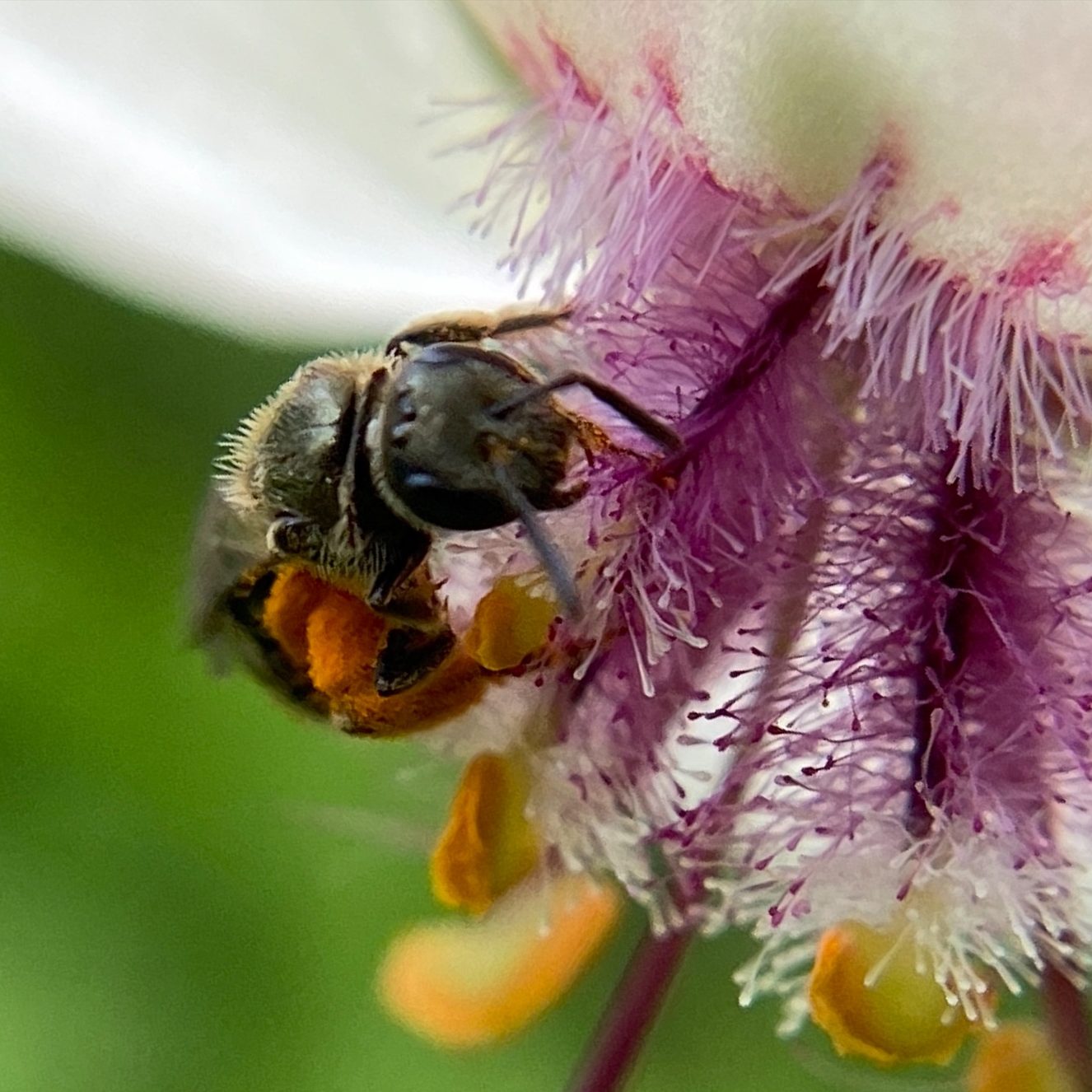
Think Like a Bee

  • Bee Overwhelm

    This week I want to talk about bee craziness.

    Last night I was up at 3am, my mind revved up on anxiety, trying to sort out my bee problems.  The hives have moved full gear into swarm season as we are in a huge nectar and pollen flow.  That means they are throwing out swarm cells, also known as queen cells, so that 1/2 the hive can fly away with the old queen.

    So, noticing this trend, I decided to start dividing and splitting them for new hives before they swarmed on me.

    That’s when the trouble began….

    As I proceeded to move queen #1 to a new location with some of her entourage, in my haste, I accidentally picked up queen #2 and dropped her into the yarrow bushes.  I never did see that one again.

    With one queen moved out, and another queen lost, the girls went into high speed—building even more queen cells.  This time Emergency Cells——-a particular kind of Queen Cell which protrudes straight off the middle of the comb. It is saved for purposes of: “O NO!  We are now leaderless!”.

    Between the two hives, I found about 10 queen cells at last count.That’s alot of queens waiting to hatch. I am haunted by all those queens running around, fighting and stinging each other to death until the strongest one wins.

    To boot, I thought I lost queen #1 when i went to open up her new palace and see how she was doing.  Things looked rather miserable in there, with very few workers and no sign of Ms. Queen.  I figured she had not liked her new digs and absconded with most of her workers to an unknown destination.

    So I decided to combine this now seemingly queen less hive with a third hive, freshly built.  This hive was also building queen cells—make that 12 queen cells all told—between three hives.

    Surprise!  When I went to check on them days later, it looked like queen #1 had resurrected in Hive #3.  That doesn’t bode well if the hive is building a new queen cell. The hive will ball her up and kill her for their allegiance to their own freshly minted in-house queen.

    I’ve created a monster. No wonder I’m having sleepless nights.

    Ridiculous, you might say. I agree.  I definitely don’t want to lose sleep over a bunch of buzzing insects.

    But I do want to do right by them. I feel responsible.

    So, I did what I should always do in my life when I am feeling overwhelmed.
    Reach out to others.  Keep on calling until I find someone who’s available to help.

    I finally was able to find someone.  T. J., our elder on the beekeeper block here in Albuquerque.  Grandfatherly and kind, full of wisdom and gentleness with bees, he listened closely, asked a few questions and then reassured me that I wasn’t a terrible person or failure of a beekeeper. The bees are just doing their thing.  I had a few options.  It was up to me how I wanted to proceed.

    I came away, newly encouraged, empowered, feeling a deeper sense of peace and calm, and clarity about what I needed to do to make sure the hives would eventually be “Queen-right” again.

    Faith. I needed that. A lesson for all of life.

    Thank you T.J.

    NEXT WEEK: a bee photoshoot so you can see some of my magnificent girls, beautifully filmed by Ralph Lind.

  • Bee-ing in the contemplative mind

    Today I woke up on the proverbial “wrong side of bed”.  It was my Sabbath monday off, but it seemed that I felt out of sorts about everything.  From my cat who offered me her dead sparrow, hoping to delight me,  to my annoyance at a request made at the last minute by my husband, just before he went off to school.

    After a long, slow breakfast with chai in my favorite bee mug, and some time to read and journal, I decided it was time to finally do that beehive split I’d been putting off. I hoped that the bees would help reverse my restless unhappiness and calm my nerves.   Many beekeepers find that the long, sustained focus of working their hives and the slow movements can often change one’s mood.  It is the  contemplative mind.

    My goal this day was to take a few combs from one of my hive’s baby bee brood, along with fresh eggs, into a new, smaller, half size top bar mini-hive (also called a ‘nuc’). The bees would take it from there and hopefully create a new queen.  It was my first endeavor with this.  I was anxious.  I had never done this.  What if I messed up.  What if I didn’t give them enough honey and pollen to keep them alive while they raised up a new queen?  It could take up to 6 weeks for this process to occur——from the queen hatching to mating to returning as the newly crowned, fully spermed queen.

    I began by opening my “mother hive”, which has always been my steadiest and gentlest hive.  It was lovely.  Full of beautiful combs with nicely balanced baby bee brood and fresh pearly white comb. I am always in awe of fresh comb.  It is not something to take for granted.

    According to research: Honey bees consume about 8.4 lbs (4 kg) of honey to secrete 1 lb (500 g) of wax (Graham, Joe. The Hive and the Honey Bee. Hamilton/IL: Dadant & Sons; 1992; ISBN)

    That’s alot of flowers visited.

    I closed up my mother hive after observing this hive’s steady, calm rhythm.  It was like clockwork.  Predictable. It inspired the contemplative mind. Peace. Something one could count on in a world that often felt impatient and  full of uncertain human dynamics. A queen-right hive is a hive to behold.   A queen-right hive is a hive with a prolific queen.  She is young, beautiful, active and strong. She inspires confidence, stability and sustainability in the workers. Much like a good leader in any institution.

    Then I opened my second hive.  I’d noticed that this hive was not like my mother hive in any form or fashion.  This one was a handful.  I always saved this one til last, since I never knew what I’d find.  It unnerved me a bit.  Sure enough, it was wildly productive.  When I opened it, roiling bees shimmered everywhere around my hands and veil.  They were putting up honey like crazy.  The queen had been busy laying tons of eggs, contributing to the wall to wall bees. This time when I went in I noticed that the girls were building a new queen cell and there were more drone cells than regular ones. They were getting ready to fly away.  Likely because they were feeling crowded. It was my job to relieve them of some of their population by taking a few bars for my mini-hive, along with the queen cell they were building.  This would be my “nursery”.  An experiment in raising a new queen.  But it would also set back this prolific hive.  I wasn’t sure how it would affect them, when their numbers were diminished.

    In the ideal world, splitting a hive can lead to a new hive and a new queen.  But it also means less honey for that year. Sigh.

    By the time I placed a few bars from my rollicking hive into the mini-hive I realized I didn’t have enough baby brood for new bees. I would have to rob my mother hive.  I was adverse to doing this, since they had settled in so well and were quietly amplifying their numbers, slowly but surely.  But I needed a good full bar of brood. As I put the final touches on closing and sealing the new nuc, a bee fell out of the mini-hive.  She looked larger and longer than the other ones.  She seemed unwilling to fly, and mostly crawled around. I tried to catch her. Did i accidentally swipe my queen from the mother hive, my beautiful queen right hive? That would be a disaster for my mother hive.  Had I carelessly taken that final bar of brood, without noticing the queen?

    She flew into the yarrow and disappeared.  I was sick to my stomach. My contemplative mind disappeared.

    Half an hour later, after googling numerous sites dedicated to “What if my queen fell out as I worked my hives?” I realized that I had a 50/50 chance of her finding her way back to my mother hive.  The only thing I could do was check in 4 days later and see if I found any queenly activity such as freshly laid eggs.  If not, they were in trouble—and I had caused it.

    My instinct was to go right back into my hive and look closely for the queen, But I had already been working in their home for an hour.  Though we smoke bees when we work with them to ameliorate our scent, it is still upsetting for them.  Imagine outside workers in your house all day long, remodeling, changing or fixing stuff while you are trying to live around them. Unpleasant.

    Been there, done that.

    So, I took a deep breath and stepped away from my hives for the day.  I would leave the girls (and boy drones) alone to do their thing, with or without a queen. I would have to exercise faith. Which is mostly what beekeeping is about anyway. I would have to practice walking back into my contemplative mind without the bees help—–holding this tension between fear and faith.  The contemplative mind supposedly teaches me to welcome both the messy shadow parts of life as well as the joyous light filled things. I generally don’t do this very well.  I like things to flow along around me with equanimity. I guess that’s why I must practice daily——abiding in my Source of Love.  Of peace.  Some days the bees help me with this.  And then I take off my bee veil and I fall back into my non-contemplative mind.

    Have mercy.

  • Wonder-ful bees

    This past week I received a call from Jessie. His voice held an urgency as he asked if I were the one who could come remove the bees from his renters tree.  As I assessed the call over the phone, I realized that this was going to be something waaaay over my head.  It would involve either cutting the bees out or trapping them, both of which I had not done myself.

    So, what does a good beekeeper do when they are over their heads?  Call upon other beekeepers of course.  Text your mentor.  Google as many beekeeping u-tubes as possible related to the subject at hand.  Fortunately there is a growing plethora of beekeepers in Albuquerque and New Mexico at large. So I gave him Paul’s number, who lists himself as available to do free trap or cutouts.  Jessie was delighted for this service, gratis.  As he explained, he really didn’t want to spray the bees given the dire plight of bees. The man knew his statistics.  He was aware that there had been something like a 50% (actually 42%) loss of hives for beekeepers this past year.  They had crashed for sure.  He wanted to do the right thing. But he would spray if he couldn’t get them removed for free. Make no mistake. Seemed his renters wanted them gone and he wanted me to understand his position as a conscientious landlord.

    Well, funny thing happened.  Jessie called Paul.  Paul was finding recruits to “trap out” (https://www.youtube.com/watch?v=b9TnW4FKeHM) those bees in the tree when I was visiting my bee friend, Lulu.  So i volunteered too.

    We showed up with our veils and truckloads of necessary accoutrements that warm afternoon.  As I sat waiting for my friends, I poked my nose into the tree, bees swirling around me. I peered closely. Vibrating masses of happy, busy working bees make me feel all warm and fuzzy inside.  I marveled at those clever little creatures and how they had chosen so well.  A dying Chinese elm offering shade, with a hollow trunk, and a tiny little hole, about the size of half dollar, where the bees could secret away their babies and precious golden liqueur from the meddling world around them. It was perfect. Such little guerrilla soldiers, those bees.  Right under the noses of the sleeping residents they had found this perfect new home with ample square footage for all their sisters and the queen.  It was a spectacular penthouse for their purposes. I was in awe.

    And so, as I sat there mesmerized by their incredibly imaginative house karma, I cooked up a strategy to see if we couldn’t at least convince the renters of the bee’s ingenuity and the ample opportunity for them to learn, observing  up close in their driveway instead of extinguishing them.  After all, weren’t these UNM students living here?  Maybe we could educate them on the brilliance of having bees in their backyard.

    By the time my friends came, I was ready for the old college try.  So were they. We approached the front door and knocked.

    Jason answered the door, wiping the chewing tobacco from his teeth.  Even as we stood there, Mack came up the street from work, his white apron in hand.  It didn’t take long to persuade them of the merits to having a beehive in their tree.  After all, it was at the edge of their dusty parking lot which housed their 4X4 Chevrolet pickup trucks.  Their eyes were bright and curious.  They were willing to watch and see, granted no one was mobstung or blood was let for this experiment. I could say they were even eager for this adventure as they regaled us with stories of bees in their backyard—bees on their grilled beef platter, bees caught in the nest of their hair for a breathtaking moment, bees gently swirling around the cab of their trucks as they rolled down their windows for a closer look on their way out.

    As we told them our own bee stories, inviting wonder and awe of these marvelous, resilient creatures, we assured them that these bees were gentle and certainly wanted to avoid them at all costs.  Their willingness increased. They agreed to call Jessie, their landlord, and tell him they were growing more comfortable with the idea.  We said we’d be at the ready, there in a nanosecond if something should go awry and the bees became less accommodating at their picnic table and around their trucks.  We all but shook hands, and parted ways with good cheer.  Crisis averted.  Major intervention sidestepped.  A graced moment for a beekeeper, who knows all too well the sad fact that bees would be sacrificed, along with the queen, for a trap out operation.

    Wonder and awe prevailed.

    I occurs to me that sometime just a little more persuasion, a little more passion and yes, a little more time taken to educate, could save us from ourselves—–our human need to possess, manage, control, destroy, change our world to our liking. We forget that other creatures are also working hard for right livelihood, to live in peace and maintain a safe dwelling for their young.

    Wonder and awe can lead us down that yellow brick road to the glory of that which we do not yet understand or know.

    So, I leave you with a few images, hopefully to inspire your wonder.  Thank you Google and National Geographic.

    Mesmerizing timelapse video shows bees’ entire life cycle in just over 1 minute

    http://www.nationalgeographic.com/features/140114-bee-native-macro-photography-insects-science/#.VUE3CoujNca?utm_source=NatGeocom&utm_medium=Email&utm_content=multi_20150504&utm_campaign=MultiProduct

  • Are Honeybees an Invasive Species?

    These days tens of thousands of small time hobbyists and backyard beekeepers have popped up worldwide. The alarm has been sounded about the dire plight of bees and people are learning about the fascinating secret life of bees and implications for our food system if our free pollinating service goes away.  You’ll see people in funny suits and hats with face nets, on any given day, turning up on their urban roofs, out in their tiny city postage stamp yards, or on rural acreage administering smoke to calm the bees, as they examine their hives.

    These days you can mail order a queen and her court ( a “nuc” consists of roughly 10-20,000 bees for starter kits).  No one needs to know anything about bees, you just need the suit and the hive, and a bunch of bees.  Let ’em go to work. Right?

    Well, no.  It’s a steep learning curve.  I apprenticed and read voraciously for a year before ever even attempting to start with real bees. They are wild creatures.  And they deserve the respect due the mystery of their nature.  As you have already read, I have messed up, failed my bees, and killed a few in the process of trying to be helpful. They usually have a different idea than humans of what is right.  We can do more damage than good, if we don’t become good disciples of that which we embark upon to tend and nurture.

    And talking about invasive species——did any of us know that there are thousands of different kinds of native bees, that hatch every year from the dust, to also serve as pollinators—– all specifically evolved for certain plants?  Are we pushing natives out by the import of apis mellifera, the humble honeybee, originally brought from Europe? Likely. They compete for the same habitat.  And with the loss of wild habitats, including habitat that is poisoned or changed by chemicals and GMO’s, and what we humans classify as weeds (what???pull up or exterminate that dandelion?  NO!!!! it is the first and most tasty morsel the bee will find in the Spring when they come out of hibernation) bees of all varieties are struggling to survive. Turns out, we humans  could be seen as an invasive species, if you look at the technical definition: an organism (plant, animal, fungus, or bacterium) that is not native and has negative effects on our economy, our environment, or our health. With this, we should seriously consider the effects of anything we introduce (including ourselves) that is not native to an area.

    If you are a beekeeper or have any inkling you’d like to “bee”, I encourage you to begin by learning about your eco-system and those native bees that live there first——how can you preserve their habitat and learn their ways, even as you begin to prepare for adopting your nursery of honeybees. I know, I know, honeybees benefit us humans—which is exactly why we love them.  But we desperately need all types of pollinators these days. And that means paying attention to all their habitat.

    And, we need more backyard beekeepers than ever if we are going to make it through this time of crisis and bridge to a new flourishing of our food system for all beings.  Don’t get me wrong.  We need you.

    For anyone who pays a whit of attention to the daily news, you will learn that bee colony collapse disorder and the demise of the bees is on the horizon. Over the past 5 winters. commercial honeybee keepers——those guys that haul their bees across the country on huge semi flatbed trucks for almonds in California, blueberries in Maine, strawberries in Florida—- have seen losses of 30%.  “Last week a consortium of university and research labs announced that beekeepers lost 42.1 percent of their colonies between April 2014 and 2015, an 8 percent spike from the previous year, and that the number of summer deaths exceeded winter deaths for the first time since the survey began in 2010.” (http://www.Washingtonpost.com, “What’s all the Obama Buzz about Bees”, May 18, 2015)  Thankfully, President Obama has begun to take notice and recently his administration announced the first National Strategy to Promote the Health of Honey Bees and Other Pollinators, a bureaucratic title for a plan to save the bee, and other small winged animals and their breeding grounds. (http://apps.washingtonpost.com/g/documents/politics/national-strategy-to-promote-the-health-of-honey-bees-and-other-pollinators/1554/)

    Should we be worried?  Yes.  Personally, I lost all my backyard hives last winter.  It’s hard to know what happened when you open up what seemed to be a thriving hive at the end of summer, and find a ghost town with nary a bee, not even a dead one.  All I know is that bee-kill has made grown men weep—not only because of the loss of their livelihood, but also because of how devastating it is to lose those for which one has become accustomed to caring.  There is a fondness, an interdependence and care that grows up between the beekeeper and their little bees.

    Bees—native or domestic—perform about 80% pollination around the world.  One tiny honeybee can pollinate over 300 million flowers a day. Seventy out of the top 100 human food crops, which supply about 90 percent of the world’s nutrition, are pollinated by bees( http://www.greenpeace.org/usa/en/campaigns/genetic-engineering/Bees-in-Crisis/)  These are staggering numbers.

    You gotta admire them. They are ancient and fierce little creatures. Evidently the oldest honeybee fossil, found by Cornell U. research, was 100 million years old.  Wow.  And so, as they perish, so goes the human experiment.  Bees are the current canaries in the mine. Resilient, adaptable, but struggling to exist.  And if we don’t wake up soon to the brilliance and absolute necessity we have for these tiny insects, our food system will be not only impoverished, but thrust into a severe crisis.

    The message from agribusiness, The GMO project, and major chemical companies is that everything is o.k.  No worries.  But public skepticism is growing as we see the bees losing,  due to immune issues such as mites, disease,  whole colonies dying or becoming confused and never making it home, as well as habitat loss.  Research now shows that neonicitinoids in backyard pesticides/insecticides, glysophates and broad spectrum, systemic herbicides found in GMO’s Roundup products impact their neurological and immune system.  Bees are stressed to the max.  And what stresses the bees, is also stressing us.  I leave you with a few wise words from those who have gone before…

    There is not an animal on the earth, nor a flying creature on two wings, but they are people like unto you.”
    –The Koran (sacred scripture of Islam)

    “Until he extends the circle of compassion to all livings things, Man will not himself find peace.”
    –Albert Schweitzer

    “By ethical conduct toward all creatures, we enter into a spiritual relationship with the universe.”
    –A. Schweitzer

    Even one thing befalleth them: as the one dieth, so dieth the other; yea, they have all one breath, so that a man hath no preeminence above a beast: for all is Vanity.”
    –Ecclesiastes 3:19

    Coming up next time…Wonder

  • Drones, drones everywhere!

    Sounds like a headline from The New York Times…except that drone warfare is usually a bit more covert and less advertised in the human world.  In the bee world, drones have nothing whatsoever to do with warfare. They are not harbingers of death and destruction.   They are a far cry from being warriors.  They are gentle, bumbling and harmless in that they don’t sting. They are life affirming in that they carry the genetic material for a hive. They are kept around the hive purely for reproductive reasons.

    Yet drones are problematic in a way.

    In the Spring buildup, queens will often lay eggs for a certain amount of drones.  A large quantity of them may be a signal that the hive is considering swarming——getting ready to pack up the old ailing queen and leave the neighborhood for a new zip code. That then leaves the old hive with a new virgin queen who goes out on her Spring mating flight to find a “drone congregation” in the area for fertilization.

    Because Drones are huge compared to their compact female worker bees—- imagine an airbus compared to a small personal jet—they can fill up the hive with their sheer bodyweight and numbers.  And since they also do precious little other than carry the genetic future for bees, they lounge around consuming resources that the hive needs for baby worker bees.  They are also a easy targets for disease and mites.  The dreaded Varroa Mite loves these relatively large, lazy insects. And so, too many drones can make a beekeepers heart sink.

    When I opened up my hive this morning, it was filled with even more drone cells than last week. Ugh. What is my queen up to?  Are my girls getting ready to swarm and leave me?  Haven’t I tried to provide them with a good, clean, safe hive and a lovely backyard full of flowers?

    But one never knows the mind of a bee.  It’s a mystery. Much as is all of life.  Much as is the unseen realms of the Divine.

    And so the bees keep me in suspense everyday.  They take me beyond my comfort zone,  humbly instructing me in how much bigger are the questions in life.  Many more than easy answers.  Tending and stewarding land and plants and creatures is never something that can be completely known and controlled—though some would have you think it’s possible—squeezing out every bit of wonder and mystery for a standardized, scientific reduction of all critter and plant life.  This then leaves the door open for horrible abuses and a lack of curiosity for what these other beings might teach us as humans.  Industrialized bees, alongside everything else industrialized,  becomes a huge operation of disposable, dispensable beehives which self destruct after a season, from the stress, the chemicals, the lack of respect for their nature.

    Because I like to keep things in order—–shape things, make my world nice and neat—the messiness of beekeeping is a good practice. Even today my girls were cross combing—–making honeycomb between the bars and welding them together with honey and babies.  Again.  Ugh.  And so I made a clean cut between the two top bars, exposing the white ghostly fetuses of baby bees in the womb and opening a vein for honey to drip.

    The bees will fix it and hopefully begin to draw out nice straight comb.  But one never knows.  In the end, bees have a mind of their own.

    My work is to learn to think like a bee, so I can be less disturbing when I go into their home and poke around in service of “bee-keeping”.

    Maybe it’s the bees that keep me.

    After all, I offer them nothing, and they in kind offer me honey and pollen and hours of fascination.

    Coming upIs the sweet little honeybee an invasive species?

  • Lessons from the hive: Babies, babies everywhere

    I opened my new hive this afternoon with fear and trembling.  The one where the bee massacre happened. It was a mess inside.  Soft fluffy piles of newsprint were strewn across the hive floor.  The back of the hive was piled high with shredded paper and roly poly white worms. Outside the hive door was a little pile of detritus and dead bees which the janitor bees had carried outside. They had a big job before them.  I remembered the piles of rubbish in the streets of India where the trash pickers would sort and recycle, reducing the community’s refuse. I guess every society has a specialization of labor——human and critter.

    Fortunately, the bees had made fast work of the newsprint which I had used to separate the two original feral hives. The goal was to keep them from attacking one another until they grew accustomed to each other’s scent.  They had chewed through to each other and were now one united community. I mused to myself, if only human communities could so quickly figure out how to live and work together, putting our differences aside…innately knowing that we need one another more than we need endless conflict”. It seemed clear to me, practically speaking, that ongoing conflict and war is just plain tiresome, eating up precious community resources.

    And so, this day, I rejoiced that my hive seemed no worse for the wear,  lacking in PTSD. The hive was flowing with honey and new baby brood.  Of the 3 queen cells that I had counted in the hive last week, all had been chewed open and the hive now appeared to be calm and “queen right” ———evidently there had been one conquering queen.  What a relief.

    I remembered last Saturday, out at the Albuquerque Open Space where our Master Beekeeper class learned about queen bee rearing from Melanie Kirby, of Truchas, NM.  As if to highlight her morning session, we went out to the hives for a hands on lesson in queens, only to find that the hive we opened had not one queen cell, but at least 4 or 5.  Jackpot. As Melanie harvested them, we watched them all begin to hatch in our hands, before our very eyes.  I had never seen such a “hot” hive.  What did these crazy bees have in mind with all these queen cells?  Melanie was delighted with these local beauties and handed them out like candy to us. I guess that advanced beekeeper’s dream of having their own locally grown queens.  The idea is that they represent  resilient stock, adapted to their environment and filled with genetic DNA from locally reared male drones.

    And then we saw it….up at the top of an olive tree nearby.  A football sized swarm of bees dangling gracefully.  Students quickly repaired to gather suits and boxes to catch this mother swarm from the hive with all the queen cells. Now we knew what the bees were up to in the hive. Multiple new queens for more nurseries. Babies, babies everywhere.

    We all love babies.  And bee babies are no different. They are cute. Tiny, with blond, fuzzy abdomens. But, wait, those little darlings are not just adorable. They hatch out ready to work. Their short lifespan begins as a nurse bee to other newbies, graduating to middle age tasks (age 12-21 days) of building honeycomb, keeping the hive cooled or warmed, cleaning the cells, and guarding.

    Finally, as a mature bee, they spend the remainder of their days foraging as a field bee.  One would think that this is the pinnacle of bee life,  blissfully immersed in pollen, drunk with nectar.  But don’t be fooled. Bees are workaholics, and perhaps like humans, don’t spend much time lolling amongst the flowers, savoring the nectar they sip and lovely surroundings.  Instead, they race from one pollen glutted stamen to another, eager to bring home more, More, MORE, distracted by so many flowers, so little time….

    And so, I offer you a word of wisdom from Mary Oliver…

    The Messenger

    My work is loving the world.
    Here the sunflowers, there the hummingbird — equal seekers of sweetness.
    Here the quickening yeast; there the blue plums.
    Here the clam deep in the speckled sand.
    Are my boots old? Is my coat torn?
    Am I no longer young, and still not half-perfect?
    Let me keep my mind on what matters, which is my work,
    which is mostly standing still and learning to be astonished.
    The phoebe, the delphinium. The sheep in the pasture, and the pasture.
    Which is mostly rejoicing, since all ingredients are here,
    which is gratitude, to be given a mind and a heart
    and these body-clothes, a mouth with which to give shouts of joy to the moth
    and the wren, to the sleepy dug-up clam, telling them all,
    over and over, how it is that we live forever.

    COMING NEXT WEEK…What’s up with all those Drones anyway?

  • Lessons from the hive: Bee Massacre

    Sometimes learning what to do means suffering through what not to do.

    After ascertaining that my hive was queen-less, I began the search for a queen.  After my first cold call, DJ, a fellow beekeeper, kindly offered me a queen-less swarm which seemed to be thriving.  He is one of the bee whisperers in town. He is called when bees have flown the coop for a new address——usually hanging out in a football size ball ‘o bees in unwelcome places such as attics and eaves and the neighbor’s trees.

    When I went to pick up DJ’s swarm it was a cold rainy day.  Bees hate rain. They stay inside.  That was good for us. We handily tied them up, locked up the door tight so they couldn’t get out, and bundled them into the trunk of my car.  I also had the queen warming inside my shirt. My mentor had given me a few queen cells that she had harvested the day before,  which I could hang in amongst the nest of honeycombs as soon as this new swarm was safely in my hive. The trick of queen cells that have been harvested is to keep the temperature between 80-90 degrees Farenheit while they are en route. I tucked them between my breasts, figuring that since my body temp is 98.6, those queens would stay warm. Despite such TLC one could never guarantee queen cells amputated from their colony could survive outside the hive for 24 hours.  I crossed my fingers and off I went.

    The day continued to unfold with rain and hail.  I hoped and prayed that the sun would come out for even an hour, so I could put my new girls to rest in my established hive.  Hey, it’s New Mexico.  The chances are always good for sunshine.

    By 4pm sure enough the sun showed up. I got my white sage smoker going and began the careful process of transferring the new bars of bees into my already established queen less hive—- after first putting in a newspaper between the established hive and the newbies, so that war wouldn’t break out between these two established colonies.  The newspaper trick gave them time to smell each other out and chew through the paper when they were quite ready to become one big happy family.

    To my horror, as I took the bars of honeycomb loaded with bees and baby brood out of the little box I transported, I realized that these combs were waaaaay too long for my established hive. DJ’s hive was much deeper than mine, thus the combs were not going to fit.  Sick to my stomach, I knew what I needed to do.  I would need to cut the honeycomb in half, in effect decapitating baby bees that were still incubating.  It was the only way to make them fit.  It was traumatic to take a knife and cut the comb, smooth as butter, in half, watching baby bees fall out of their comb cells, still not quite formed, tiny white, entombed ghostly bees. My knife became sticky and full of bee fluids.  Honey that had been stored to feed them, began to drip everywhere.  The nurse bees designed to care for the pupae, attached to the outside of the comb, began to stick in the honey, falling from the comb and the knife. This is not how beekeeping is supposed to go.  I want to report the happy stuff. This was a nightmare.

    But the lesson from the hive was not to be happy this day. It reminded me that life regularly presents me with adventures and misadventures all at once.  Learning is often painful and downright wretched, requiring me and all of us to put on our big boy/big girl pants and face the music.  Sometimes it is a mess we have created. Sometimes it is a problem that was already there and cannot be solved without pain—someone or something is going to get hurt.  It is the way of being and becoming human.  It is painful.

    But there is new life.  And in this resurrection season, I am hopeful that my bees will sort out the mess I have made of their beautiful combs and go on to raise more generations of bees. Thank goodness a bee’s life is only about 30 days long.  Hopefully the trauma will die out with one generation— after they have righted all my wrongs.  Bees have a way of doing that.  They are brilliant, innovative and downright resilient.  I’m trying to learn these things in the face of my own suffering, pain and seasons of messiness.

    Maybe the only happy thing to report today was that the swarm had plenty of new queen cells on their combs and I added mine into the mix.  A couple of new queens should emerge soon. I hope there isn’t too big of a fight for the throne.

    I left the hive with my girls huddled in a ball around the desiccated combs. I set the severed brood comb on the floor of the hive, praying that my girls will still be able to nurture these embryos detached from the comb and hatch them.  I said a prayer of thanksgiving and breathed one asking forgiveness for my harm.

    Even as I closed the hive up, the rain began to pelt me again.  I made it inside just as the hail, big as golfballs rained down, plinging on the tin roof of the hives and the skylights in our house. I felt some consolation in knowing that they now had a safe, dry, expanded home.  But i grieved the picture of carnage left behind.

    God help us in the messes we leave behind.  We all do it.  Countries. Individuals. Communities.

  • Lessons from the hive: is there a queen in the house?

    Queens have many statuses and meanings in our society.  Royal blood to be preserved. Anachronistic relics from the past. crowns of state. Powerful.  Powerless. Dignified beauties. High maintenance girls. Gender at play.

    In the hive, queens are the mules.  They carry all the genetic material for the next generation.  Her sole function is as the reproducer.  A well mated and well fed queen can lay up to 1,500 eggs in comb cups per day—more than her own bodyweight in eggs.  If she begins to lose her reproductive power, her pheromone scent will wane, often leading to a de-throning, a showdown with a new queen that the girls have raised to kill the old.  Yes, there are no wise, sagey elders in the colony, ageism is rampant.  The workers generally die of overwork after 30 days, and are replaceable. A good queen can last up to 5 years, but that is rare these days, 1-2 is more likely, given the toxic world around them.  And yes, there is also sexism in the colony.   The whole colony of worker bees are girls, except when mating time comes around every year. Then there will be some boys, otherwise known as drones, who are quickly disposed of if the colony is bursting with new babies and they are taking up space and resources. Out on their backsides, into the unkind world beyond to fend for themselves.

    And the world for busy bees is a hard cold, reality these days.  Both for the city bee and the rural bee. There are the unprecedented wildly swinging temperatures which might cause a hot day in December and a freezing day in May when they are supposed to be dancing in the flowers collecting nectar.  Their favorite flowers, including weeds, and fruited trees are often doused in insecticides and pesticides by well meaning gardeners.  Over time, this will weaken and kill a whole colony.  Genetically modified roses and plants have seeds that are coated in those very same pesticides, infecting the flowers.  A society of the survival of the fittest, indeed.

    When I went to open my hive yesterday, I was concerned that it be “queen right”, meaning—-without a queen, the colony will surely perish, soon.  This particular swarm of bees was collected off a tree by my bee mentor, Carolyn.  She brought it to me with reassuring words that it was a strong colony and likely held a virgin queen.  O no!  A virgin?  That would mean she needs to go out on her dangerous mating flight alone and find some local boys to give her sperm for life.  It could be that there were no drones in the neighborhood.  It could be that the Spring winds would swept her away to another county, another zip code, and she would not make her way back.  O no!

    For a week I held my breath as the girls oriented to their new home.  They seemed to settle in after their initial angry and confused sprawl into this large covered box.  I waited and watched.  Pollen being brought in is a good sign that babies are due.  Pollen being the high protein food of choice for baby bees.  Lo and behold, I caught sight of a few leg sac full’s of pollen scurrying into the doorway over the weekend.  Eagerly I put on my bee hood and took my smoker and went to check the nursery.  Nothing that I could see in the way of eggs, larvae, baby bees, a queen. Only a swarm of bees busily hanging new comb.

    If there is no queen sighting soon, I must find one for them.  Time is of essence since it takes 21 days for a honey bee to grow from egg to adult and begin it’s work.  All my current bees could be gone by then.  A haunting thought.

    I’m wondering where I’m going with this….what exactly is the lesson from the hive today? How about this? Make sure there’s good, strong women to bring about the next generations.  Take good care of them.  Give them rights, education, a voice.  Let them do the work they are called to.  Provide a healthy, safe world with clean water, air and soil for them to grow up the little ones of the future——else there be a ghost town, a shell instead of thriving communities.

    And remember, if mama ain’t happy, ain’t nobody happy.

  • Lessons from the Hive

    I begin my day with Tai Chi in a wild haze of bees.  My golden girls.  Sun lovers. Their little energizer bodies are built like solar collectors.  Sunlight and heat will immediately set them in motion.

    I too am a sun worshipper.  When the mornings begin to warm up, I am eager to start my day outside amongst my bees.  Here in New Mexico it is already 70 degrees at 10am.  I slowly move my limbs up and down, in circles, back and forth. The bees are shiny in their morning flight, the sun careening off their vibrating bodies.  They ignore me or go around me if I am in the way.  Their main concern is flowers. Flowers, flowers, flowers…and water.  These things go together like wine and cheese.  Flowers represent the life-force itself—filled with ripe centers of pollen and nectar for their expanding brood.  Water being something we have precious little of in the Southwest.  Water being 70% of our bodies. Water being something we should kneel down and offer thanksgiving for every time we encounter this liquid. It is more precious than gas and oil.  Rubies and gold. Money and techno toys. Big houses and fast cars.

    Water is life itself. Bees know this.

    I am happiest in my backyard, amidst a profusion of flowers.  It is Spring and I am flanked by periwinkles that curl around the brick wall, piles of Purple Robe Locust clusters and Apache plume bushes mounded with white flowers and buzzing bees.  The smell of bees is comforting to me.  Whiffs of warm nectar and honey issue from the hives as I open them.  There is the more musky smell of propolis—used to tack everything together. Bee superglue. The colors of pollen in the comb are reds and golds and yellows and even purples.  Colors of a New Mexico sunset. Colors of the flowers.

    For the newcomer, the inside of a hive can be terrifying and intimidating with upwards of 80,000 tiny bodies vibrating and working like there is no tomorrow.  Bees know how to work.  Always on behalf of the common good of the hive.

    I am at peace when my hives are full and expanding. They represent vitality.  Aliveness.  I am connected to this when they are thriving.  Though we might not know it, we need bees. 30 % of our food sources are cross-pollinated by bees as are 90 % of our wild plants. (https://www.nrdc.org/wildlife/animals/files/bees.pdf). We are mostly blissfully ignorant of this. We think that the little honeybee will always be there for us, plying her trade in our GMO Roundup Ready crops and pesticide infected yards, flowers and fruit trees. Yet, bees are dying. I lost all my hives last winter. And it was a mild winter. Like the Lorax —who picked up the skin of his rump and soared away from his over-chemicalized, over mechanized, smog choked and dying planet with a warning—-so is the message of bees today.

    I begin this journey today, as a pastor and a beekeeper.  I want to explore the question—as communities, can the bees guide us to a more hopeful future as we learn to think like a bee?