Think Like a Bee

  • Spirituality of Bees

    O.k. you knew I’d get there, right?  You’ve probably been counting to 100 saying, “Wait for it”. So, here it is.  As a spiritual seeker, ordained person and beekeeper, with a blogpost called “Think like a Bee”, it’s time.

    So, I’ve been musing on this subject.  It is bigger than I.  I have a few crumbs to offer. Certainly there are a million tangents this could take.  But I will share with you some writings from this past week, which by the way, found me in Southwestern Colorado, the San Luis Valley.  It is ringed by mountains. Pockets of hot springs are scattered throughout.  Many of the famed 14-er peaks are there. Here’s a few other factoids from our favorite Oracle, Wikipedia.  Just in case you want to take a road trip.

    IMG_0076

    The San Luis Valley is an extensive high-altitude depositional basin in the U.S. state of Colorado with a small portion overlapping into New Mexico covering approximately 8,000 square miles (21,000 km2) and sitting at an average elevation of 7,664 feet (2,336 m) above sea level. The valley is a section of the Rio Grande Rift and is drained to the south by the Rio Grande, which rises in the San Juan Mountains to the west of the valley and flows south into New Mexico. The valley is approximately 122 miles (196 km) long and 74 miles (119 km) wide, extending from the Continental Divide on the northwest rim into New Mexico on the south. The San Luis Valley receives little precipitation and is made up of desert lands, but the temperatures can be very comfortable in the summer and very cold on winter nights.

    So, I offer two things that seem to me to be about the “Spirit” of the bee e.g. it’s essence, it’s being, it’s connection to that which is Divine…communication and the love of light.

    rlind_MomDayBioPark_0512_6

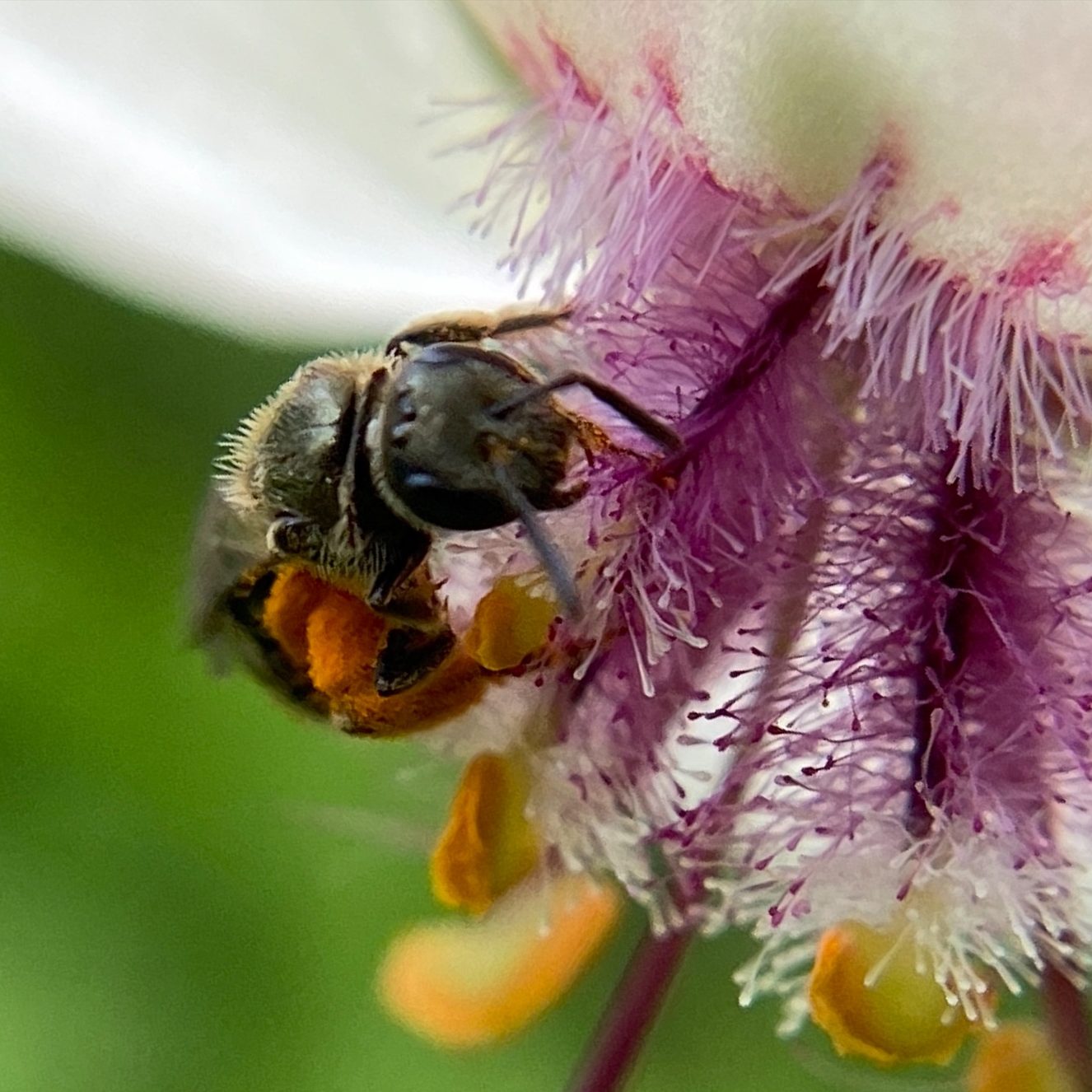
    Communication is not just relegated or confined to like species. Inter-species communication is an amazing thing. It is now known that bees have constant communication not only with one another, but with the plants they pollinate. “Flowers, which can be fickle by nature, are difficult to contend with. [They] may only be open for certain hours of the day, remaining open for varying length of time; some demand the right weather conditions before they will produce pollen and make it available” [1] Flowers of course have distinct bright, beautiful colors, patterns, scents. These make flowers all the more attractive for bees as they forage. But Flowers also have patterns with an ultraviolet spectrum, a petal temperature, texture and shape. “We’ve found that by producing these combinations of sensory stimuli, the plant basically makes its flowers easier for the bee to learn and remember” says Dr. Anne Leonard, a researcher from the University of Nevada.[2] And even more tintillating is that flowers have a slightly negative charge and bees have a positive charge from flying through the air. When bee meets flower, the electrical charge is neutralized so the next bee flying by, doesn’t need to stop and say hello, since she will know the flower has already been pollinated—it has lost its electric charge. Amazing. Inter-species communication.

    One thing that has also become clear over decades of concerted research of bee colonies is that they are guided by an innate intelligence that often belies their insect category. They communicate with the celestial bodies and energy fields of the planet. Bees attune themselves to the magnetic field of the earth and orient themselves constantly to a huge universe beyond their hive, for a sense of direction. They orient their GPS systems to the great sun god, much as ancient human communities did. Though they live and work in complete darkness at home, they are light loving and will quickly move towards it if trapped in an unfamiliar place.   “Light to a bee represents warmth and life; it must be akin to the sun itself….moving towards sunlight is, for a bee, instinctive and logical” [3]

    Every major religious tradition calls us towards the light and a deeper attunement to our deepest being, to the Divine and those around us. It is called many things—-enlightenment, transformation, bliss, nirvana, born again. The hard, often austere spiritual work that must be done with one’s own soul in order to achieve this light, requires finding and sweeping clean the cobwebs of our emotional baggage. It requires us to “wake up”. Become aware of our surroundings. Face our busy, distracted “monkey mind”, as the Buddhists teach. In the Eastern school of chakras, we must clear out and attune to our third eye or sixth sense. Or, as Jesus taught, allow our blindness to be healed, taking the log out of our own eye rather than trying to judgementally pluck the speck out of the eye of one’s enemy. The goal of all the great religious traditions is to allow the light to seep in. As the cracks begin to appear, perhaps a river begins to flow as the clogged channels are cleared. Once these gateways to the light are unstopped, they created pathways of new thought and clarity for the heart —-more readily open to the Divine’s Loving gaze and transformation. Perhaps the bees in their great love of light and flowers and a delicately honed sense of their surroundings, can show us the way to our own Source of Being as we begin to reflect upon and connect to their humble but focused lives.

    [1] William Longgood, The Queen Must Die and Other Affairs of Bees and Men (NY, NY: W.W. Norton and Co, 1985) 70

    [2] Adam Cole, NPR interview (February 22, 2013) “Honey , It’s Electric: Bees Sense Charge on Flowers”

    [3] William Longgood, The Queen Must Die and Other Affairs of Bees and Men(NY, NY: W.W. Norton and Co, 1985) 55.

    Not many bees to be seen, but they must’ve been out there with all the mounds of chamisa in bloom. This is one of my all time favorite places to be…I offer a few things from my time in this glorious place.

    So

  • On the dole

    IMG_0705Today I felt a little bit like Uncle Sam. (Why is this print green? Perhaps to highlight Uncle Sam’s favorite currency, the greenbacks…?)  Almost all my girls in the hive are struggling.  They have a bumper crop of brood and babies, and amazingly, prolific New Mexican born queens and no honey.  Yep.  A few weeks out from Winter officially setting in and there has been a worrisome dearth of nectar and pollen.  That lovely photo of comb filled with honey, which you see above, is nonexistent in my hives.

    All the beekeepers are feeling it.  Most of my bees seem to listlessly crawl around the hive door, or come back from the field empty handed, day after day.  When I opened the hives today, bar after bar of comb was sock-dry.  Old Mother Hubbard went to her cupboard…

    I hate to feed bees.  It feels so….domesticated.  But I’m not above it, if it means they won’t starve.  When I went down to my South Valley location today, crawling over the fence——gates were locked and Lorenzo, the organic farmer was gone—- my bees were fiercely protective as I opened the hive.  They crowded around the queen, desperate to save her, even if the whole fort was going down from starvation. So, I began to drizzle Moses honey, from Los Ranchos, on the floor of the hive.  Moses always has honey.  He stocks all the shelves of Whole Foods and the La Montanita Co-op.  By the time I left, the girls had begun to calm down and march to the bottom of the hive to sip at the lake of honey oozing across the floor like an oil slick. If you’ve never noticed, honey is part aphrodisiac, part nutrition.  Honey always makes the hive mellow. Consider how you feel after slathering honey on toast or taking a spoonful of this sweet delicacy. The girls were entering some euphoric, nirvana state by the time I left.  Or maybe it’s just called happy bellies. They began to ignore me.

    Below is about 7 combs of honey saturated with happy bees…(not mine, obviously)

    IMG_0692

    Unless one of my bee friends comes through with a cutout, where I can swap sweat equity for some bees and their honey, I will be feeding my girls every week for the next month.  Which got me to thinking about public welfare and this thing about being on “the dole”.  There is an often a sneering opinion of those who “can’t do for themselves.”  They are the unfortunate ones who end up with food stamps and public welfare benefits each month. We look at them with scorn or pity in the grocery line— sometimes thinking charitable thoughts about those who are so poor they can’t buy their own groceries.  We don’t know their true stories.  What on earth happened?  How did it come to this—- depending on Uncle Sam and “our” tax dollars to feed their children.

    Well, if it’s like my bees, it has to do with a series of things that go wrong and a system that just isn’t working on their behalf. I can tell you what happened to all my girls in each of my 4 hives.  A few were feral bees or swarms that were caught in June. Which was a human intervention in the bee’s plan for their lives. Then they landed in my backyard.  Due to a series of unfortunate mishaps over the summer thanks in part to my inept mistakes and experimentation (which you can read about if you scroll down to the The Queen is Dead and Bee Overwhelm blogposts) my bees lost their bank accounts.  Otherwise known as the Queen Bee.  She either died, absconded, was ailing or lost.  And so the girls had to start over by growing a homespun queen with their own spit, sweat and royal jelly.  They had to wait for weeks and weeks for their queen to grow, to hatch, to mate, to return. And there was never a guarantee that she would return.  During this time, they languished.  No next gen to take care of the oldsters.  No social security bennies or other providers in the household to bring home the bacon for these girls. And during that time, they lagged behind.  They lost a generation of field bees to go find precious resources such as nectar and pollen.  Now the droughty Fall had taken ahold and though they all have a resourceful and resilient queen, and they are hard workers themselves, they still might not make it because they just can’t get ahead.

    Think minimum wage.  One will never be able to save on that sad little amount each hour.

    And so I feed them.  Like a providential hand from the sky, reaching in to shower food upon them so they can begin to eat again, gain strength, move beyond just survival to hopefully thriving.  I hope to see them pack away that honey over the next few weeks so they are ready when the snow flies.

    So, here’s my rant.  It seems to me that most young families or single headed households (mostly women)who live on the edge are kicked off the cliff when a crisis comes.  They work hard. I know women.  Multiple jobs to pay childcare.  Or part time work pieced together or just staying at home and receiving a public check because childcare cancels out wages.  But, it is next to impossible to save on a minimum wage or a part time job that doesn’t keep up with inflation or food prices.  And so people turn to Uncle Sam.  Or “the dole”, as some would call it.  A hand from the sky reaches in to give a bootstrap up. And if you think it’s easy street, an average maximum check from the government is about $675/month for a family of three–which can of course be reduced if you report any income at all.  Which puts you below the poverty line.

    Recently I read on a website, “if you had profits between 300 and 1.5 million British pounds before April 1, 2015, you may be able to claim marginal tax relief to reduce your corporate tax” (https://www.gov.uk/corporation-tax-rates/rates)

    Hmmmm.  I’ve heard of corporate welfare and “relief” in this country for the ultra wealthy…but the Brits do it too?!  Colonizers unite. And what about all that medi-care-y, comprehensive Obama type healthcare that all our congressional staff get—red, green, blue or purple—no matter what your political stripe.  Could that be considered welfare?  I remember when I was a poor seminary student, on California’s public health plan. I was glad for it, but it was never a comprehensive plan.  I waited in doctor’s offices thick with sick people. For hours. Some of the care shocked me.  Some of it was excellent.

    Well.  Time to get off my grandstand.  Bedtime.

    Just thinking tonight about how everyone, even bees, the most hardworking of all of us, need a little help on those bad days——and sometimes just plain and simple, bad years.

    rlind_anitaamstutzbees_061215290

  • Survivor

    rlind_anitaamstutzbees_061215172

    This past Saturday I received my Beekeeper Certification.  After two years of classes and fieldwork, 12 of us graduated with our pins and certificates of capability… or maybe just sheer stubborness.  One of our instructors, Susan, continues to comment that, like the t.v. show, we are the survivors. We began with 24 second year beekeepers for this certificate and only 12 are left standing.  Ours may not have been a deserted island, but sometimes it felt like it.  This second year of our certification program we were on our own in a rigorous and sometimes punishing schedule.  It required us to put in at least 40 hours of community service, at least 10 instructional classes and a looong summer of  field hours with master beekeepers who were veterans.

    As you’ve seen in my blogposts, I’ve tagged along for cutouts of beehives in water cisterns.  I’ve helped with 3 foot combs, tucked away in adobe walls.  I’ve assessed trapouts in old trees and under the eaves of garages.  I voyaged up to Truchas to shadow Melanie Kirby, the Zia Queenbee raiser of resilient, mite resistant, strong New Mexico stock.  I learned about hive splits and divides and how to increase pollinator habitat thanks to Plants of the Southwest. And in the midst of all this, I continued my own backyard bee trials and tribulations as well as mentoring new beekeepers, and teaching elementary school children.  It was a blur.  I’m sure I’m leaving something out.  I just can’t remember in this groggy pre-bedtime state.  All I know is that I’ve learned plenty. Whether I am a bona fide, certified beekeeper or not, what really matters is that I’ve learned to listen better to my little bee friends, and let them mentor me in a thousand different ways.

    rlind_anitaamstutzbees_061215282

    I’ve lived through queen supersedures, deaths and misadventures of dropped queens.  I’ve had hive die-outs, mites, combining of feral hives and swarms. I’ve learned to recognize queens without magnifying glasses.  I’ve had hives come after me—bees in my nose, ears and hair.  I’ve been stung endlessly and I still have an affection for the little critters. Go figure.  Wendell Berry, the great earth advocate, tobacco farmer and prolific author wrote a speech entitled “It All Turns on Affection” which he gave at the JFK Center, upon receiving the Jefferson Award in 2012.  http://www.neh.gov/about/awards/jefferson-lecture/wendell-e-berry-lecture

    It’s worth a listen.  Wendell, whom I just found out shares the same birthday as myself (what an honor!) reminds me of why we must not just do things out of rote duty.  Caring for the earth must come from a deeper place of affection, lest it be unsustainable. It’s about relationship, in the end. Thank you Mr. Berry.  You always hit it right on the nail.

    It is Saturday night. The glory day of being honored for completing a rigorous, survivalist course is over.  The Day’s festivities and final bee presentations are all done. Back to the daily ins and outs of beekeeping.  I am glad I did the program. Not only the information, but just the wonderful networking and strengthening of the bee community through our work together.  Quoting one of the core committee members…

    As a group, you bonded well, helped each other, and challenged the planning committee to give you the most comprehensive program we could. I am comfortable speaking for the 2014–2015 planning committee to say, it was our great honor and joy to get to know you and appreciate your conscientious dedication to becoming competent and resourceful beekeepers. So, wear your well-deserved, Certified Beekeeper lapel pins boldly and often. You made history on August 22, 2015.

    Cert Beeks Class 2015

    So be it. But lest I think that now I am an expert, my bee friends will continue to humble me regularly.  One never really keeps the bees. They keep us.

    My husband and I pop the cork on my special Mead honey wine and celebrate with our friends who graciously host one of my hives.  We sit in the waning light under a long portico, overlooking the backyard with our bees.

    Life is good.  Long lives the bees!

    rlind_anitaamstutzbees_061215122(1)

  • Bees, Lorenzo and Santolina

    Recently I met Lorenzo Candelaria, an heir to one of 6 original families from Spain who were deeded vast tracts of land in New Mexico.  He is part of 300 years of tradition—- land that has been in his family for 7 generations.  We connected at the Growers Market in my neighborhood where he was surrounded by young handsome men with long black hair and beautiful smiles, a mixture of family friends and interns who work his farm. Close to seventy years old, Lorenzo usually wears a trademark handkerchief around his neck, a straw hat and overalls.  He is small in stature, as a former horse jockey, but what he lacks in height he makes up for with a robust spirit and eyes shining with curiosity and intelligence. We connected over bees and spirituality. He invited me to come and see what he is doing on his family land.

    Today I finally took him up on his generous offer. Lorenzo has 4 acres of family land down in the South Valley that he brought back from the brink of decay over 20 years ago.  As a middle aged man, he returned to his home from a career as a horse jockey.  Beginning in Chicago, he ended up criss-crossing the South and mid-Atlantic states racing horses for which he had a natural affinity and experience.  He describes that time in his life as intense.  A time of skyrocketing to financial success, but leaving him empty inside. He called the business “corrupt and ugly”.  Farming for him was like taking a breath of fresh air after not breathing for a long time. Lorenzo dug up the trash that had accumulated, began to irrigate, nourish the land and plant food. He jokingly said that he is still looking for a tractor that disappeared. It took him 15 years to clean and prepare the land. It was full of Chinese Elm, an invasive species that sucks the land of water and nourishment. Now, after 5 years of production, Lorenzo’s land has more food than he knows what to do with.

    He sells food, gives it away to the community, brings young people from schools in to learn about it and to work on the land.  He says, “Farming is not a vocation or a hobby, [for me] it’s a passion”.  For Lorenzo, this place leaks life giving energy and he radiates the joy and love for the land which he has nurtured back to health.  He basically understands this call as a way to serve his community and Mother Earth, whom he talks of reverently and respectfully as a member of his own tribe.  There are row upon rows of succulent blackberries, a half acre of asparagus, chili, blue corn, pumpkins,cucumbers, and an outdoor year round kitchen and hoop houses.

    What does all this have to do with bees?

    As Lorenzo talked about his land and the relationship that he has cultivated with it, I felt the same sense of connection that I have with my bees, welling up in my own heart. He talked of the food he grows as not just edible plants but a living life force which create consciousness as you partake in growing, nurturing and eating their gifts. “Every cell of your body reacts to “real food“, he said, his eyes lit up with delight. Yes. This is what I feel when I eat raw, freshly harvested honey, pollen or propolis from the hive.  All of it is living food. All of it has healing properties, untouched by chemicals or human degradation.  It is a sacrament from the bee’s gift economy —–given by their very life and hard work.

    He talked of the deep spiritual aspect to the food growing tradition of his ancestors.  He talked of the spiritual growth that comes from caring for the land. “We don’t own the land, the land owns us.”  This flouts the Western European concept of ownership. It reminded me of my own Judeo Christian tradition in the first book of the Torah, Genesis, where we find the cosmology of the ancient Hebrews.  The second creation story, chapter 2, calls for Adam (among other things, Adam means dirt being) to “til” and “tend” —-care for the land—-not dominate it. It’s about relationship. Lorenzo lives this.  Money is nothing, he states.  Our true treasure is food and water.  They are everything.  Money is an illusion. If the Rio Grand River runs dry, we will learn this lesson quickly.

    This brought me to another reason I was there.

    Lorenzo and other the South Valley farmers and nonprofit groups have been fighting a massive development in the South Valley, a 38,000 home mega-development by British multinational bank, Barclays.  It would turn the sand dunes of the New Mexican desert into a high end village, siphoning off upwards of 12m gallons of water a day in a land where people, land and animals always live on the razor’s edge of drought.  As Lorenzo said, it would reduce his water flow drastically, along with other farmers and dwellers along the river. It would create infrastructure for water and utilities that the city of Albuquerque and tax payers like myself would be paying  forward.  Public welfare, I think they call that. Santolina would abut a valley that is not only rich in history and tradition and land, but also ridden with gang violence, poverty and other societal afflictions.  The development would be a travesty.

    Lorenzo was featured in the Guardian recently: http://www.theguardian.com/cities/2015/may/19/barclays-city-new-mexico-desert-santolina-urban-sprawl-albuquerque

    After a sham of public forums to invite the communities to speak out—the voices packing the rooms being overwhelmingly against this development—the County commissioners, Art De La Cruz, Wayne Johnson and Lonnie Talbert basically handed over the land.  I, along with Lorenzo and many others in the Valley, would like to follow the money.

    Water is not only life, it is blood in the veins of New Mexicans. Over the centuries it has proven more than once to be bloody as generations have fought for it’s right.

    At the end of our tour, I noted Lorenzo’s beehives at the edge of the farm, empty and cob-webby.  At one point, he said he had over 20 hives.  “Mmmm, blackberry honey…”, Lorenzo smiled as he remembered. Due to the sickening practices of agri-industry and urban life—-our romance with chemicals for everything from mosquitos to roses to food—–his bees had also become run down with mites, diseases, colony collapse.  He gave it up.

    Maybe someday again there will be blackberry honey, if I have anything to do with it.

  • Why They Fight

    Is it just animal nature to fight?  After reading a whole book called Bee Time: Lessons from the Hive  by biologist, Mark Winston (Cambridge, MA: Harvard U. Press, 2014) about how bees as a superorganism exemplify cooperation and communication, I find my newly acquired feral hive dragging bees out the door and throwing them off the porch to their death.

    I am deeply distressed.  Especially if I have caused this behavior by trying to combine a weak colony with the stronger hive. Have I misread some clear signs, causing them stress, leading to this aggressive behavior? Usually combining hives is quite successful with the paper trick.

    I think back to both of these hive’s recent string of events.  They were quietly minding their own business, having finally found a home in a human dwelling.  Suddenly, they were cut out of their home, plopped in a box with some of their hard won honeycomb. Perhaps they had a queen, or perhaps the queen was lost.  Now they are refugees, temporarily living in a backyard, until they are given to a new owner, arriving at her home on a blustery, rainy night, under the cover of darkness, disoriented and reduced to a small box with 10 frames.

    My friend Sarah tells me I’ve done all I can.  Now it’s up to the bees to sort it out.  Of course, this is always the case.  We humans intervene and try to “keep” bees, but in the end, they keep us.  They teach us. Take us into their mysterious, unknown, feral places which we cannot fathom.  And perhaps we learn about them…but mostly we learn about ourselves.

    What I learn about myself is that I hate violence and death. My first instinct is to save them. Stop them. Intervene.  But it is futile.

    I remember that video called Why We Fight, a Eugene Jarecki documentary, first screened at the Sundance Festival in January of 2005. It examined the 50 year military industrial complex of this country, the U.S.A. and how endless wars continue to fuel our economic system.  I don’t remember much of the details anymore.  It’s been over ten years since I’ve seen it. But what I was left with was the haunting question of whether there is something in the human psyche that drives us to violent and bloody wars, against our better judgement.  Can Love or good religion overcome that urge?

    Today, I also heard on the news that we are living in one of the greatest migrations of human beings, due to wars, religious and political violence, economic injustice.  The numbers of displaced people, on the move from those things that rip their lives apart, is staggering.  The U.N. reports over 45 million on the move, more than half of them are children. This doesn’t even include internally displaced persons.  Endless wars—conflict and persecution— are destroying people, cultures, countries. Will the human race survive without killing one another completely? Why do we as humans continue to fight when it clearly is destabilizing?  Why do we fight when, practically speaking, it creates huge headaches for all of us, a mess of society, and generational trauma?

    Meanwhile, my bees fight.  And I stand by helplessly, pondering how much we are alike—-humans and bees.  And I hope and pray that we learn before it’s too late, that we must lay our weapons down, because it is in our best interests to cooperate and create a sustainable future for our elders and our children. Believe me, I’m self interested enough to want to live in that world.

  • Moving bees

    The appointed hour arrived at 7:45pm on Saturday night.  The storm clouds were cropping up in the western sky, warning us of the late night thunderstorms of the monsoon season. My friend Sarah arrived in her huge yellow GMC truck, ready to haul bees from near the base of the mountains, down to the valley, along the Rio Grande.

    Darren Jewel, whom I introduced you to last week, (the bee cutout expert) had gathered a few hives of bees from his travels.  He was hosting them in his backyard until we could come pick them up and take them to their permanent home.

    Just a little inside scoop. It is best to move bees after dark, to ensure that all the field bees have come home for the night and no one is left behind. Even so, there were still bees flying around and as night encroached, I began to feel like I was in the twilight zone.  It was creepy moving a pulsing, vibrating mass of insects trapped inside a box from one side of the city to another, at night. I had fleeting glimpses in my head of that newsclip about an overturned semi-truck of bees migrating from North to South to pollinate the fruit there.  I can’t imagine the horror, both for the driver and the bees.

    One hive was particularly cranky. As we smoked them, trying to urge them inside in order to tape the door shut, they continued to fly around and chase us. When one stung Sarah on the cheek, we got our veils.  It was time to get down to business. They were feeling jittery, just as we were.

    Finally, everyone was loaded up…three hives in all.  Sarah began to carefully wind her way down to the river even as the clouds gave up their goods and the rain fell.  I wasn’t hauling a bunch of live bees, but my stomach was churning, just thinking about trying to move them to a new location in the dark. I had gained permission from friends to put one hive on their property, but they weren’t home and I had ended up with not one, but two feral hives. I felt anxious going into someone else’s backyard at night.  I hoped that the neighbors and their dogs would extend us some grace.

    At the other end, the rain had abated enough to let us unload. When Sarah’s truckdoor opened, the classical music poured out.  I asked my friend if she felt anxiety about driving the bees in the rain and thunder and lightning.  “Oh no.” she laughed,  “If you’d seen some of the other situations I’ve had to move bees in, you’d see this is a piece of cake”!  Sarah is a can-do woman.  She is of slight build, spunky and smart.  In her professional life, she appears to be an East Coast bred, genteel woman who wears pearls.  But down in the beeyard, she is fierce and strong and knows her stuff. I was grateful for Sarah’s unabashed confidence that night.

    We unloaded the hives and left them at their new home until tomorrow, when we would come back and do a thorough hive check and see what was going on.

    With our headlamps, Sarah and I were able to move everything without much ado.

    The next day, though, was wild and wooly as we checked the hives, particularly the cranky hive. I’ll spare you the details, but I ended up being chased, suffering stings in my private parts. A day in the life of a beekeeper.

    Why do I do this?

    My friend Sarah helped me answer this question as we grabbed a Red Stuff drink at Flying Star and shot the breeze about bees, poring over catalogues and swapping bee equipment ideas.  Yes, we are geeks.. beeks as it were.

    She said it was her small way of giving back to the planet.  I thought about that.  There are hundreds of thousands of ordinary people who give back to our earth and support the food system by daily caring for their “girls”. The bees.

    This is especially relevant because of a recent unfortunate and misguided, sensationalistic local Albuquerque t.v. news piece on “Blood Thirsty Bees”—-chronicling a community trying to bring attention to a bunch of very cranky bees. I wish the t.v. station had chosen to balance their story with some investigative journaling—-educational facts, real stories of beekeepers and the uniquely difficult and joyful job they perform—–of contributing to our planet’s health and food security. Who knows what happened to the beekeeper on the West Side. Was he in over his head?  I’m not going to sit in judgement. I’d need to hear his story.

    Yes, it does happen that bees can have “hot” or partly Africanized DNA, which can become a hazard in communities.  They need to be taken care of—-either placed far away from people, requeened or put down.

    The lion’s share of beekeepers are responsible, ethical, deeply respectful of all life. They care that bees are disappearing and colonies collapsing.  They worry about life without pollinators—-responsible for at least 70% of all the foods we eat. They love what they do and they do it well and with all their heart—for the bees and for all critters, including people.

  • Bee Cut-Outs

    IMG_0685 IMG_0703

    So this is what we beekeepers look like when we go out to visit our beeyards…and do cutouts. Some kind of outer space weirdos.

    This particular cut-out was on a piece of real estate in Placitas, New Mexico, atop a mesa, with a stunning view of the sunset. It was evening when I went in as a master beekeeper intern to assist Darren Jewel and his wife, including their adorable 7 year old daughter.  They warmly welcomed me tagging along.  They are veteran cutout artists who rarely lose a beehive cutout—whether a wall, an eave, a roof, or an airduct.  Their expertise and gentleness in caring for the bees are, in my estimation, unprecedented.

    Our bee candidates had found a lovely, very hot home in the upstairs, external wall of a family’s second story roof patio.  The family had been rather amenable to them staying until the bees began to become more active. As the hive grew and the summer heat cranked, the bees were clearly going to become even more visible. Let’s face it, the wall the bees chose was going to be hot as Hades in a New Mexican summer, Their combs would melt like butter.  The bees didn’t yet know this when they had moved in during the warmish days of April.

    By the time we came to cut them out of the wall and dispatch them to a new home, they had filled up approximately a 3X3′ portion of the wall and made combs as long as Grandfather Time’s beard.  Darren was as uncanny as a water diviner, as he tapped on the wall and listened carefully to determine whereabouts the hive might be located before sawing into the stucco to remove a portion of the wall.

    IMG_0692 IMG_0695

    Once in there, one by one, we carefully cut off each long spike of comb, filled with bees and crammed with baby brood and honey/pollen.  Darren’s wife meticulously vacuumed the bees off (see the wooden box below with the motor on top) and we carefully stored the fresh golden/white comb in plastic containers. These would be banded to frames later and hung in a new hive.

    IMG_0700IMG_0686

    These days the temps are rocketing towards 100 degrees in the sun, almost everyday. This cut-out was a cake walk compared to many of the incredibly dirty, hard to reach, blazing hot cut-outs that the Jewel family often does—including cantankerous bees with Africanized genes.  Though those are far and few between, according to Darren.

    I spoke with him this past week.  He has 5 cut-outs queued up this week alone—alongside his regular job.  The past weekend was a maze of cutouts—one lasting at least 7 or 8 hours, til past midnight. This year alone he has given away 30 beehive cut-outs alone, free of charge, to beekeepers in the area.

    I can tell Darren loves what he does.  He never complains about the difficulties and he always shows deep respect and patience for the bees and humans in every situation—– even when he needs to “put down” a hive because it will be a hazard within city limits.  This year alone there has only been one hive like that.  For local beekeepers, this is good news.  It means that the Africanized bee genetics have been held at bay and thus public opinion continues to be friendly towards pollinators.

    Darren’s unflinching goodwill, skill and high energy keep him ahead of the game.  He is the one I would call if I ever had a bee cutout in my house.  He still refers to the bees we took up in Placitas as my bees.  “Want to know how your bees are doing?” he asked today when I spoke with him.  “Yes!” I responded.

    Evidently those girls are happily re-hived at his aunt’s home and have rocketed to new heights of reproduction.

    That guy has some kind of magic with bees that I want to learn.

  • The Queen is dead

    rlind_anitaamstutzbees_061215219rlind_anitaamstutzbees_061215146

    It was a day in the life…. per the photos above,  I had just retrieved a queenbee from one hive, ready to move her into another hive.  I was moving bees and bars around, feeling confident.

    But that feeling never lasts long when you are dealing with Mother Nature.

    Three weeks and many sagas of queenbees later, I can tell you one thing for sure, the bees will always trump and continue to surprise.  After all, they are wild things.

    It has been the summer of queens.  Trading and swapping and wheeling and dealing in queens, to keep my hives afloat.  The worker bees have done their part, producing a bumper crop of queen cells through the beautiful nectar flows, due to the rains. They have been eager to give me new queens, even as I have dropped a queen, lost a queen, killed a queen.

    Here’s the latest…

    Over a month ago, when I opened my hives, I noted that none of them had queens, but they were dutifully trying to grow queens by nurturing new queen cells.  So, I closed up the hives and left them to their devices.  After all, as one wise beekeeper has said, ‘If you don’t know what to do, it’s better to do nothing”.  In other words, “Leave ’em alone!”  it’s better to do no harm and be as non-invasive as possible with your bees if you are confused. In the end the girls know best what is going on.

    So I took this sage advice.  When I returned a few weeks ago, I noticed that all three hives still had no queens.  Queens had clearly hatched out…but where were they?  Likely out on their mating flight, according to my calculations.

    In talking with seasoned beekeepers who were still waiting for their queens to come back, only 40% of bees had made it back from their mating flights—— due to rain, wind, birds and other little problems.  That’s a miserable statistic.

    So i set about figuring out how to “Queen up” my hives quickly before all the workers died and there were no eggs or a next generation to carry on.  Luckily, or mercifully, my #1 Mother hive’s new, freshly mated queen showed up the next day.  But that still left one queenless and another with a failing queen whose conditions inside the hive were poor.  Moth worms had moved in.  The worker bee numbers were plummeting with no sign of new eggs or bee larvae, and a poor queen laying pattern.  I would have to put the old queen out of her misery and give them a new one.  Pronto.

    It’s never pretty taking out an old queen.  I felt like a hitman, hired by the darkside of the insect world.  I said a prayer over her and beheaded her.  She was now Missing in Action in her hive.  I gave the girls an appropriate grieving time.  3 hours. Then I hived my new mail order bride.

    She had arrived, jittery and clearly upset in her little cage, after 2 days of travel by mail. She was named “Chia” and had a blue dot on her back, easily identifiable in the hive.  I attached her cage to a bar in Hive #3 and within a day, my girls had chewed out the sugar plug and accepted her.   All was well.  Long live the Queen.

    No.

    The next day I came out to check on this hive with their new queen. At that very moment,  I was horrified to watch a small cadre of girls solemnly coming out of the doorway, carrying a perfectly beautiful queen. Dead as a doornail. No blue dot on her back.  It definitely wasn’t Chia.

    Suddenly it occurred to me exactly what had happened.  Over a month ago, when I thought the old queen was still viable, I noticed that the workers had been building a number of queen supersedure cells.  I had stolen one for another hive that was queenless at that time, and squished out the remaining ones, assuming their old queen was just fine.  Evidently the bees knew something I didn’t at that time.  The queen was ailing.  Her pheromones were weakening. So they did what bees always do when the queen is no longer fertile—– they were getting ready to dethrone her by building their own queen.  Despite my meddling, they had still managed to keep one of their queen cells under the radar, from my sight,  nurturing her to full strength.  She hatched and went out for her mating flight, unbeknownst to me.

    By the time she had returned, triumphantly entering the front doorway to overthrow the old, ailing queen (in other words sting her to death) she was met with hostility by the very girls who had raised her.  Faced with a strong, young virile queen who had  superseded her merely by being dropped in from nowhere, she was killed—likely stung to death and balled by the workers.

    I felt sick to my stomach.  A perfectly healthy, beautiful young queen, raised in New Mexico by my girls.  Not easy to come by.  Certainly not cheap. Now she was carried out in state and with honors, dumped off the edge of the landing board.  There she lay.  Lonely and lifeless. I gave her a proper burial.

    It was a sobering day for me as I pondered this.  My ignorance, my impatience, my oversight, my steep learning curve.  I thought about all the ways humans impose our will upon the natural world—meddling, messing, always according to our time schedules and ideas. And Mother Nature, even my girls, are forgiving.  They right the wrong and continue on with their lives— without regret or hatred.

    I closed up all my hives that day, resolved to leave them alone for a month. Resolved to learn how to move through my own transitions and passages—whether self imposed or superimposed upon me—with more grace.  More trust.  Like the bees, getting up and brushing myself off, grieving when necessary, then, going on with a positive attitude, despite the inconvenience, hardship and downright messiness of some days.

    rlind_anitaamstutzbees_061215172

  • To Bee or not to Bee

    rlind_anitaamstutzbees_061215328

    As an ordained minister, today is my first day of being congregation-less.  I resigned 4 months ago and my last day as a pastor of my flock was yesterday.  It was emotional.  A celebration and a sadness all at once.

    Not surprisingly, my bee life mirrors my real life at the moment.  I went out to check my beehives a few days before my final day as a pastor.  It appeared that all three of my colonies were queenless.  It not only triggered my own mourning about leaving my people, but it also shook me to the foundation of what I thought my foreseeable future vocation would be—-tending and writing about bees.

    Not that I ever really saw myself as the “queenbee” of my congregation….though at times it was fodder for a good joke at church… but it did seem ironic that at the moment that I was ready to leave my “hive”, I was facing a queenless future as a beekeeper.  If you know the craft of beekeeping, this is a death knell for that hive (check out my earlier post about queenright hives”)

    Did you ever notice that when one area of your life is in transition or falling apart, other areas pop up also?  As an old Amishman used to say—-sometimes bad days come in bunches like bananas.

    Here’s what I wrote the day it all hit me …

    Only 5 more days and I will be no more at Albuquerque Mennonite Church.

    A weird liminal space.  I feel tense, angry and sad inside.  I check my hives today and realize that none of my hives have a fully mated queen…perhaps a symbol of the lack of fertility and vitality that I feel in my life at the moment.  A winding down.  An ending. On the cusp of something new.  The old is dying or going away—what will be, has not yet come.

    I want to freak out….for myself, for my hives.  I need new queens right now.  My girls are not happy. They are angry and anxious without a queen to keep them “queenright” in their home.  My neck and hands are swollen with multiple stings as queenless bees are much less patient with human meddling when they don’t have mama around.

    I know that at least two of the hives have reared and birthed their own queen and if all goes accordingly, she will return as soon as she is fully mated (which takes a little sidetrip from the hive to visit the male drone congregational site—always an iffy proposition, with danger lurking as she makes her way from the safety net of the hive)

    Nature has her own mysterious timing.

    It’s like the soul.  It cannot be forced. I must be patient with all that is happening in my own soul, even as I await my queens.

    rlind_anitaamstutzbees_061215122(1)rlind_anitaamstutzbees_061215140rlind_anitaamstutzbees_061215163rlind_anitaamstutzbees_061215217

  • All quiet on the Beehive front

    rlind_MomDayBioPark_0512_6

    I know, I know, I promised a photo shoot of my bees this week…

    Due to technical difficulties, it will be delayed. Stay tuned. I share with you at least one fine image from the photographer who did the photo shoot.  He has a Nature gallery, chock full of glorious critters—-from hummingbirds to butterflies to cranes.  Soon you will see more of Ralph Lind’s excellent eye for beauty. Trust me.

    Mercifully, this week has been a very quiet one in my backyard bee world.  After the craziness of the past weeks, I covered up the hives and left them alone.

    Bees, like humans, can easily become stressed by their surroundings.

    As someone who multi-tasks too much and often creates my own whirlwind, I understand the erosive effects of this kind of stress.
    Yet, evidently, bees aren’t as workaholic as I thought they were.  They are “restaholics”, according to Mark Winston, a 40 year veteran bee biologist who who wrote a wonderful book named, “Beetime: Lessons from the Hive” (Cambridge, MA: Harvard U. Press, 2014).   Likely, it’s we humans who stress bees out more than anything, as we meddle in their home, poison their foodsources, take their food, cut down their habitat, and often don’t know what we are doing, leaving them to go back and fix our messes. Like humans, when they are stressed, the bee immune system breaks down.  They get sick.

    Mark Winston writes:

    Bees in unstressed colonies are restaholics rather than workaholics,—spending up to 2/3 of their lives doing nothing (174) But, when required they can ramp up by compressing the normal time frame of work into a shorter more intense period…There’s an obvious lesson for stressed humans here, which is that rest may have an important relationship to our lifespan and provide resilience to respond to challenges in our personal, professional and community lives.(177)

    We often use the aphorism, “busy as bees” and uphold bees as tireless, selfless, volunteer workers—something to emulate.

    But, it seems that mostly they are just hanging out in the hive—–able to switch to high gear when needed for the hive’s betterment.  Bee colonies naturally tilt towards health and balance.   I love that.

    It is a good model for communities in this country where most barely eke out a 2 week paid vacation and 60-80 hour work weeks are considered normal.

    Perhaps the bees are calling us to less work, more play, need less “stuff” so we don’t have to work so hard to pay for it, and have more time to hang out in relationships.

    Speaking of which, bees evidently are all about relationship.  Another lesson from the hive.  They relate constantly to one another through pheromones, touch/taste and dancing!  There is a very special bee jive called the “waggle dance”.   Biologists have studied this and found it to be the way bees convey directions for anything from nectar flow to the location of their next home.

    Communication, communication, communication.  Bees are all about it. They groom one another, stroke and lick each other,   rub abdomens in passing, smell each other’s scent and use their antennae to connect with one another and pass along info.

    Bees even communicate with flowers.  According to “Beetime” ….Bees carry a positive electrical charge, while flowers tend to be negatively charged, although both charges are slight. When a bee visits a flower, it triggers the flower to change its charge to positive within seconds. Subsequent bee visitors detect this subtle difference in electrical field and avoid the flower….since it likely doesn’t have pollen or nectar. An electrical conversation! (209)

    We humans, evidently are becoming more impoverished and less emotionally intelligent in this area of communication.  Texting and emails keeps us in our own little silos, cut off from the most basic ways of communicating, using the art of full-bodied conversation.  We choose not to be present to one another, person to person, which would require gestures and tone, scent and touch as ways to highlight our words.

    According to 2012 research done by Leslie Seltzer and colleagues at University of Wisconsin, conversation decreases salivary cortisol, an indicator of stress, and increases oxytocin, a hormone associated with social bonding, pair formation, maternal behavior, trust and empathy. Texting didn’t show the same effects, even between those with close relationships like mother, and daughter, suggesting it’s something about live interpersonal conversation that creates the strongest social bonds. Communication … can have a profound effect on brain neuro-chemistry. (Winston, Mark. Beetime: Lessons from the Hive. Cambridge, MA: Harvard U. Press, 2014, p.207)

    In a few days I will go to a large national convention of my faith community gathered from the four winds of this country.  We will do pretty much what bees do.  We will be in the same rooms with one another as we seek to do the business of the church.  I can only hope that our conversation in person will enhance the outcome and give us a deeper quality as we touch and smell and see one another.

    We have some big issues to work on—including whether we will be fully welcoming of GLBT persons in our denomination, or at least tolerant and forebearing of those who have a different view. May we work for the highest good of all our communities.

    Maybe we can even break into a waggle dance together.