Think Like a Bee

  • The Eyes of Future Beings Are Watching Us

    In these times of guns, war, police violence, racism, misogyny and a country burning down from it’s ignorance and fear
    I am writing.
    I am writing for my life
    I am writing to make sense of
    I am writing for the lives of those who come after me.
    I am writing because I want a more whole world.
    I am writing because I struggle to believe that
    working for the things I love…
    bees, beauty, flowers, children, animals, nature, song, dance, color, words
    are enough in a world
    so wrecked right now.
    I am writing because I want to hope again.
    I am writing because, as Terry Tempest Williams wrote, “The Eyes of the Future are looking back at us and they are praying for us to see beyond our own time.”
     I’ll let her finish…
     “I write to make peace with the things I cannot control. I write to create red in a world that often appears black and white. I write to discover. I write to uncover. I write to meet my ghosts. I write to begin a dialogue. I write to imagine things differently and in imagining things differently perhaps the world will change. I write to honor beauty. I write to correspond with my friends. I write as a daily act of improvisation. I write because it creates my composure. I write against power and for democracy. I write myself out of my nightmares and into my dreams. I write in a solitude born out of community. I write to the questions that shatter my sleep. I write to the answers that keep me complacent. I write to remember. I write to forget….

    I write because I believe in words. I write because I do not believe in words. I write because it is a dance with paradox. I write because you can play on the page like a child left alone in sand. I write because it belongs to the force of the moon: high tide, low tide. I write because it is the way I take long walks. I write as a bow to wilderness. I write because I believe it can create a path in darkness….

  • The Hive Mind

    It’s bigger than just one bee. It takes a village of bees to build a hive. One honeybee will make only 1/12 teaspoon of honey in their lifetime. It takes 80,000 or more bees to feed a hive and share that beautiful elixir of honey with humans.

    Honey bees are under no illusion that they can live without each other. And to this end they have learned phenomenal cooperation and communication in close, crowded living conditions.

    They are not conflict adverse or wary of getting close and cozy with one another to solve problems. The hive will survive together or perish together. They are interdependent upon one another in all ways. If you’ve ever seen a hive of bees swarm, you’ll understand the lovely synchronicity they operate within. The elaborate ability to act together. It is like a bee symphony.

    rlind_anitaamstutzbees_061215163


    Human communities are not so different. It is inspiring to see people care for one another in the wake of a disaster. To watch an Amish barn raising. To listen to the Venezuelan children’s symphony featured in Tocar y Luchar.

    In this political season here in the U.S., the hive mind could help us understand how to work together for the commonwealth, the common good. The hive mind is the what the best of all three great Abrahamic traditions teach us. How to care for one another. A world in which it’s just about “my” interests becomes splintered and divisive.

    Consider the following passages from the 3 World Religion’s holy texts, all descendants of Abraham and Sarah…

    Love and Faithfulness will meet, righteousness and peace will kiss (Ps. 85:10)

    Love your neighbor as you love yourself (Matthew 22.39)

    God invites you to the Home of Peace.(Quran-Jonah 10.25)


    rlind_MomDayBioPark_0512_6

    Support the work of Think Like A Bee the Month of July. Deposit a gift here to enter a “bee basket” grand prize drawing July 31. We are a tax exempt organization committed to advocacy and education.

  • HAPPY POLLINATOR WEEK!

    ….and Summer Solstice! June 20-26 is National Pollinator Week. I celebrate these amazing little workhorses who feed us free of charge by their pollinator services.

    This summer as I teach Albuquerque Public High School students the art of beekeeping, I am amazed that youth who have trouble attending in the regular classroom or struggle with emotional/behavioral issues are totally mesmerized and engaged in the outdoor classroom by their subjects—apis mellifera. The lowly honeybee.

    And why not? Bees are more like us than not. They live in communities or bee colonies. They have complex, organized societies. They have a division and specialization of labor from nurse bees to morticians to guards to architects and field bees. They work together. Things can get ugly and violent at times in the hive when survival is threatened. I won’t lie. They do some brutal things to each other. They get crabby and mean when they are hot, stressed or crowded. They demonstrate what we humans  call ageism and sexism. Not so different from our societies.

    We are more alike than different. Perhaps that’s why we are fascinated by honeybees.

    Bees will always throw you off. They will mystify you just when you think you’ve got them figured out. I’ve been duly humbled as a beekeeper for the past six years.

    Here are some amazing Bee factoids to honor their work and short 30 day lives:

    • There are over 20,000 species of honeybees around the globe
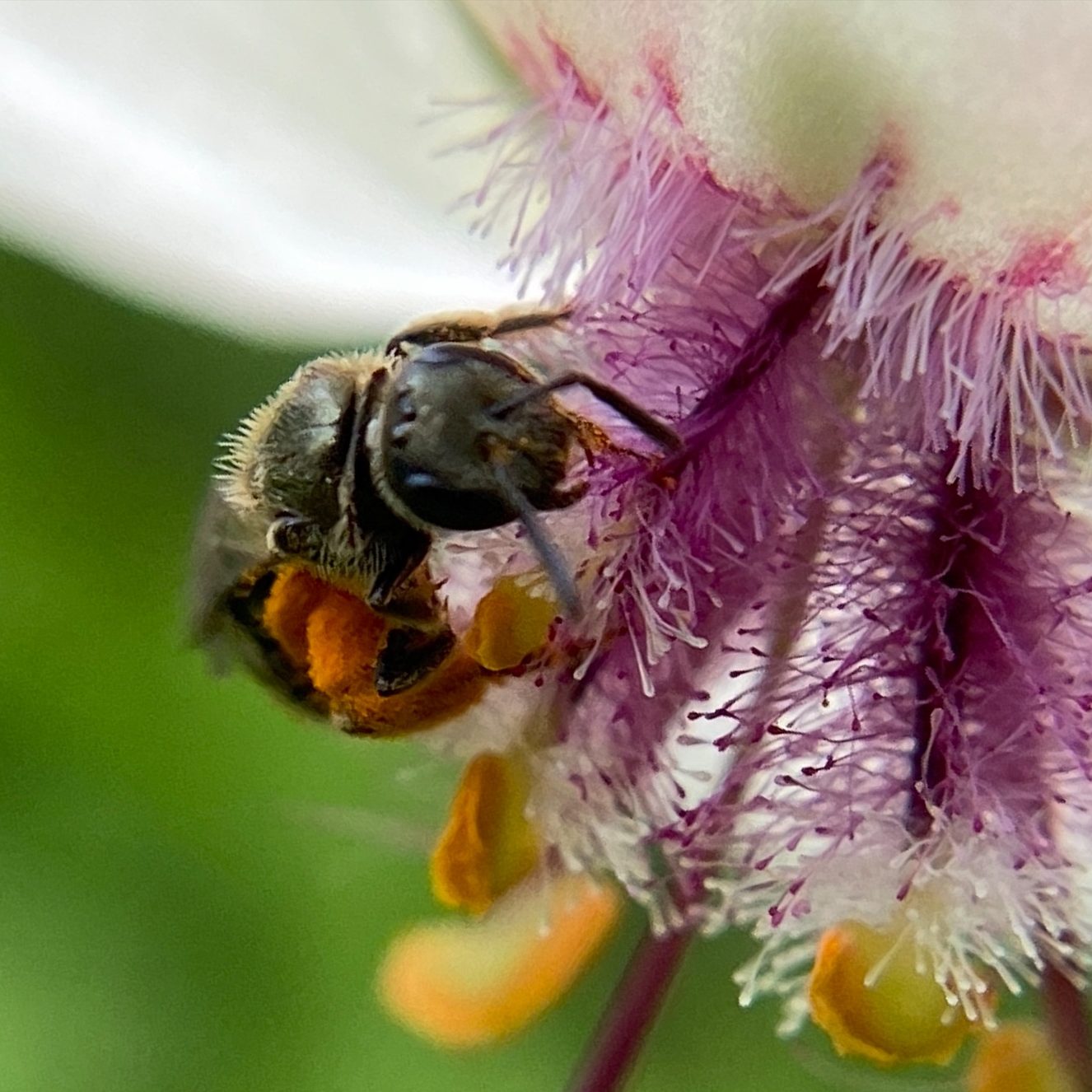
    • There are about 4,000 solitary native bee species in the U.S.A. which I have featured in this article. So beautiful.
    • All the worker bees in the hive are female.
    • The queen can lay up to 2,000 eggs a day
    • 80% of our food is pollinated by bees
    • The oldest fossil of honeybees found was 100 million years old in the Caucasas region of Russia, by Cornell University researchers. They have been with us a looooong time.
    • Bees must tap up to 2 million flowers to produce only one pound of honey. I bow to their hard work.
    • The average worker bee will make only 1/12 teaspoon of honey in her life

    At the beginning of our class, I talked with the students about “mastering” a craft. I thought they would say that “to master” meant “to dominate” “to rule”. But they said exactly what I wanted to teach them. Mastery means to “know” your subject. It means to care about your subject. To gain enough wisdom to teach.

    Perfect. I told them that we would be learning about bees. We would observe them. We might know a tiny bit more about bees at the end, but in no way would we be be able to gain mastery. That takes a lifetime. And in one lifetime, I’m pretty sure I won’t have mastery of my subject of honeybees.

    Andy Goldsworthy, is an English Earth artist who makes huge installations from natural elements in the great outdoors. Once he built a large rock art installation. It fell apart not long after he created it. Though his pieces are designed to eventually return to the ebb and flow of the natural world, he was surprised this had taken so little time. Clearly there was a flaw in the design. His choice words were, “I guess I haven’t mastered the nature of the stone yet.”

    I feel the same way about bees.

    Support the work of Think Like A Bee this National Pollinator Week. Deposit a gift here. We are a tax exempt organization committed to advocacy and education.


  • Bee School

    So, on a lark, last year I dreamed up this idea of collaborating with Cornelio Candelaria Organic Farm in the South Valley and the NM Acequia Association to teach beekeeping and the art of farming to youth.

    I wrote a grant. It got funded by Albuquerque Community Foundation and now  we are in business.

    Last week we officially began our summer program with the student interns from APS schools. They are a group of young people, handpicked by the inimitable Travis, a dynamic young 28 year old man who is committed to connecting youth with the earth and our food system. He is an amazing musician.

    One teen couple has a baby. They are still finishing school.

    Another young man plays the saxophone and doesn’t say much at all. He keeps his eyes mostly downcast.

    Miguel is interested in the medical field. He goes to a charter school focused on that.

    Eva has “emotional problems”. That’s what I hear at least. When she’s at the farm I find her to be highly engaged and incredibly smart. She loves the farm. She feels at home.

    It’s a place to let one’s hair down. Doesn’t matter if your feet are muddy or you talk too loud or you don’t have expensive tennis shoes or nice clothes. All are welcome.

    Many of the students have never been exposed to bees. So I told them that anyone who doesn’t want to work in the hive or is allergic, is exempt. I want the hive to invoke curiosity and wonder, not fear and resistance. Surprisingly every last one of them raised their hands to go into the hive.

    This is one of the programs that Think Like A Bee will continue to fund for the future.

    Wednesday, June 15 is the first ever for New Mexico…….BEE AWARENESS DAY!

    This will be followed by Pollinator week, June 20-26. Hug a pollinator next week and help keep our momentum for Burque Bee City USA moving forward.  Go fund us at:

    http://thinklikeabee.mydagsite.com/

    Feel the Buzz!

    ... <b>bees</b> for <b>kids</b> – honey <b>bee</b> games for <b>kids</b> – <b>bee</b> stings <b>children</b> (15


  • BURQUE BEES

    Dear faithful readers,

    This morning I awoke at 3am, anxiety ridden by a mind gone amuck with disaster remediation. I had seen the the official NBA size basket ball clump of bees hanging on the outside of my strongest hive before I went to bed. Our dinner guests, friends visiting from NYC, saw it. Their eyes agog, they gasped in awe at the breadth, width and length of those bees. But I was terrified.

    They signaled to me that time was awasting. These girls were getting ready to swarm and take most of my honey and my queen.

    So, you can imagine the way the mind spins it’s fear in the middle of the night. I awoke, rehearsing how I could quickly get in and out, splitting the topbars…one for me, one for the girls, one for me, one for the girls…until they were no longer crowded, hot and irritable.

    You’d be crabby too if you lived in a house with 80,000 warm bodies. In 96 degree temps. In New Mexico. No central air conditioning.

    But that wasn’t the only reason for my trepidation.

    Today is my official launch for Think Like A Bee’s BURQUE BEE CITY Deposit a Gift crowdfunding experiment. http://thinklikeabee.mydagsite.com/home

    It raises the same kind of stomach churning in me… But I figured out that if each of you who faithfully read my blog, contributed the minimum of $25 each, we’d be well on our way to our $7000 goal! And I wouldn’t have to do this again. Maybe never. I’ve applied for many grants, and we are looking to receive some of that funding later in the year.

    Meanwhile, Think Like A Bee needs your help to get the word out about pollinators as  we head towards Bee Awareness Day, June 15 and Pollinator Week, June 20-26, 2016.

    Meanwhile, Albuquerque is on the verge of becoming the first BEE CITY USA in the Southwest—if the City Council so moves to put into place this resolution for pollinator protection in the Big Burque!

    Meanwhile, the bees need your help. With 44% losses in 2015, again, it’s not just about saving cute fuzzy bees and attractive pollinators like butterflies and hummingbirds, it’s about our own existence. Native bees and Honeybees, the workhorses of our food system, pollinate over 80% of what we eat. But they are in trouble. Because of our human habits.This is about a healthy food system for humans and all life on the planet…

    Here’s what your tax exempt donations will continue to support:

    • Funding Inner City youth interns and our summer beekeeping/organic farming course
    • BURQUE BEE CITY RESOLUTION grass roots organizing and Education in the local schools, at farmers markets, neighborhood coalition meetings and local civic group
    • Ongoing public advocacy for pollinator protection an Pollinator Collaboration with Wild Friends, Albuquerque Garden Council, New Mexico Acequia Association, Cornelio Candelaria Organics and more..

    You might wonder what happened with the hive splitting activity…

    Loss of life was minimal. I now have two hives where I had one before. It was as rugged as I imagined. All those bees were very angry at my uninvited presence. I am considered a predator, after all. They were well stocked with honey and I am a threat to their food stores. I have a few well placed welts inside my bee veil to keep a healthy respect in place.

    I invite you to Deposit a Gift on behalf of bees today. http://thinklikeabee.mydagsite.com/home
    Thank you!


  • BEE PATIENT

    Last night as I was sleeping,

    I dreamt—marvellous error!—

    that I had a beehive

    here inside my heart.

    And the golden bees

    were making white combs

    and sweet honey

    from all my old failures

    –Antonio Machado,”Times Alone” trans. by Robert Bly (Prayers for Healing, Berkeley, CA, Conari Press, 1997)

    I feel like I’m in Sunday School again. Learning the basics. Patience is a biblical virtue. I’m notoriously terrible at it this virtue. Those closest to me will tell you. I am a do-er. I like to start something, push through, see results. But the bees are my spiritual teachers in this realm.

    Last week I was working the hives with my friend Lorenzo down at his organic farm. Now you have to understand, Lorenzo is 70 years old. He has alot more patience than me. It was the first time we had really gone through the hives to see exactly what was going on with each one.

    We were so under prepared. And overwhelmed.

    The first hive had not only birthed a new queen after I split them and took their old queen a month ago—they had begun plotting for more queens, in order to split the hive themselves. It’s part of their natural instinct against overpopulation. Take half the hive and leave. But for a beekeeper, we don’t want to lose half our hive. These days it can spell disaster. They move into houses and offices and gutters.  Places where they become a nuisance. Then beekeepers are called to deal with this more complex situation. A headache for all.

    The hive that day was packed with honey and bees. I didn’t quite know what to do with all that exuberant bee activity. We had no extra hives. So we began to harvest honey. As the bees became more rattled, I became faster and faster in my movements. This can only cause more anxiousness for the bees. At some point, Lorenzo sat back and just let me work. His instinct is to slow down, when mine is to hurry up. Get this over with.

    We should’ve slowed down. Lorenzo was clear as we mused on it later—bees can sense anxiety. Our movements make all the different….how can we do this as mindfully as possible? It is a grace to work with an elder. He, along with the bees are mirroring my emotions back to me. His admonition is more gentle than the bees! Both of us were soundly stung that day—many times. Both of us felt we could’ve done better by the bees.  First, by being prepared.Secondly, by slowing the scenario down. Bees were stinging us.  They were getting squashed, drowning in the honey, their honey, that we were sawing off into a bucket. I made some hasty decisions.

    A few days later, as I worked in my own hives, the lesson of patience came back to me. One of my hives had no queen. So I decided to take a queen from another hive and present her to them—before doing the research on why they might be queen less. Act first, research later. Often my motto.

    But one quick read up made my stomach queasy. There should be a virgin queen running around in that hive, one they had nurtured to maturity.  A good sign was that their hive is filled with honey and pollen. They must just be waiting for her to be mated. I ran back to the hive and quickly removed the queen that would be killed for sure—if the true queen showed up. Then I remembered this exact scenario happened last summer…

    Once a teacher said, if you don’t know, or have questions about what you are doing to your bees. Stop. It’s better to do nothing and let mother nature take her course than to meddle and mess them up.
    That particular day, I was very aware of being patient. Interestingly, the bees were exceedingly patient with me. No stings while I was up to my elbows in bees.

    Maybe I am learning.

    rlind_anitaamstutzbees_061215217


  • Participatory Universe: Loss & Life

    “We live in a participatory universe”. So says Franciscan priest, Fr. Richard Rohr, Spiritual Teacher and author. He is quoting a little known British philosopher, author and poet named Owen Barfield(1898-1997).   These words continue to rise up like leaven in me, all these years later. I am still only a beginner in understanding the meaning of this on a visceral level.

    But something happened this past week that drove it home on more than just the mental plane. I got it on a physical level. Bear with me…this will be a longer blog than usual.

    I was driving to Colorado, along the remote highways and byways of New Mexico, with such stunning scenery, it never fails to take my breath away. As always, when I drive into these parts, I say a prayer. Actually I say many prayers. I name the animals, plants and waters that populate places, giving thanks for their humble lives. I ask that they stay safe and far away from my vehicle. As you can imagine, it is not only for them, but my own self preservation. If you’ve ever heard a story from someone who has hit an elk, a deer or a wild mustang at high speeds in New Mexico, it has left an imprint of trauma—physical and emotional. Not to mention the vehicle damage.

    Personally I would be traumatized if I hit even a squirrel. And so I ask for safe passage. I have never had a vehicular/animal encounter since I have practiced this—my deepest fear being that if I hit a creature, it would suffer, meaning I would have to participate in this also.

    But this particular day, my unbroken record failed. As I slowed to enter a small town, marveling at the prairie dogs along the side of the road, suddenly, a tiny junior gopher was facing me directly at the intersection of my tires and the pavement. I didn’t have enough time to slam on the brakes (which likely would have been deadly), swerve or honk. There was a sickening crunch as my tires rolled over this baby. In my sorrow, I knew I needed to go back and carry my slain little friend off the road, as a way of honoring his life. This is always a matter of practice—to carry roadkill and gently place them beyond the ribbon of death, to avoid the continual assault by vehicles. It’s a small way of honoring their lives, as well as to give any other predators the green light to come and feast safely.

    The amazing thing was, as I drove back to the site of the slain prairie dog, my stomach gripping, before I could even pull over, a massive sleek, shiny Raven swooped across the road carrying the little one to safety. A nice little treat for him. The circle of life was unbroken. It was a gift for me to see this circle of life and death triggered so quickly. I didn’t even have to gaze on the tiny critter’s broken, destroyed body. It was a grace. It was indeed a Participatory Universe, and I could only hope that my willingness to be awake and aware and prayerful on the road, allowed me to participate in a way that was life affirming—one creature among many, seeking safe passage in this life. And if death is imminent, a mercifully quick end and a return to the wheel of life by supporting another’s breath and being.


    I sometimes think of my beekeeping this way. I participate in the Universe by working as reverently and kindly with my sister bees as possible— hopefully bringing consciousness to the work. In a time when losses of bees are disturbingly unsustainable (44% losses last year), I invite you all to participate in whatever way you can. Whether it’s planting native pollinator plants. Or refusing to use chemicals. Spending time observing your non-human kin. And always, always seeking to do no harm, acting with compassion and sending prayers of goodwill and blessing their way. All of it counts in this Participatory Universe. It is a two way street.. It creates a reciprocity in our relationships. A communion of beings, rather than a collection of objects, as Thomas Berry, the late theologian and ecologist wrote. Shalom. The original vision. As a former NM land commissioner, Ray Powell said, “If we take care of the land, it will take care of us”

    In June 2016, Think Like A Bee will launch Bee Awareness Day and Pollinator Week activities. There will be ways to participate very concretely, with your money, your time and energy to support bees here in New Mexico. Now more than ever, they need friends.

    Stay tuned…

    cropped-cropped-img_0705.jpg

  • Bad News (and good news)About Transitions

    How did the rose ever open its heart

    and give to this world

    all of its beauty?

    It felt the encouragement of light against its being

    Otherwise we remain too frightened.  (Hafez, 14th c. Persian poet)

    This past week I spent a fair amount of time picking up a small swarm….it was a mess of bees clinging to a fork in the branch. Standing on my car, I thought I could just sweep them into my insulated grocery bag.

    Instead they suddenly took flight, as my brush gently swept across them. It became a profusion of bees flying around my head and my husband, who happened not to have a bee veil on his head. Then the stings came. They were not happy girls.

    I closed my bag. It wasn’t optimum, but I would have to come back and collect the rest later since a clump of freewheeling bees refused to be caught, dancing around my car, eventually re-clumping in the tree branch.

    When I returned later that evening, the disoriented group—tiny in size now—seemed to recognize my car and began to fly around. I swept the next group in from the tree branch and then opened my grocery bag on my car hood.  One by one, they began to fly closer and closer, until, as they smelled their sisters, they marched into the bag. My patience paid off. Traffic driving by, looked closely at this odd carnival sight on the side of the road.

    I wanted to tell the independent or frightened bees what awaited them..a warm, dry tiny house, with food stores of honey that I had pulled from another hive.

    Unfortunately they weren’t having it.

    Sadly, I had to leave behind a handful of bees who were either too frightened or to obstinate to come with their sisters.

    I pondered this bee situation in light of real life. My life. I often do this. The reality is, sometimes things get really messed up and chaotic before the good stuff that awaits us in times of change and transition. Things have to fall apart, and sometimes trust, versus suspicion, is a better quality.

    rlind_MomDayBioPark_0512_6


  • BEES, BREW and BEE CITY USA


    Bees have become popular little poster girls these days. We are increasingly aware of their decline and the critical role they play in pollinating all things food. In effect, they are life itself. We are enamored of them because they supply us with that sweetest elixir of all—honey. Perhaps you’ve heard of the new Kactus Brewery in Bernalillo. The owner, Dana Koller, believes in bee rescue, but he also loves beer. He has acquired a few beehives and soon he will be experimenting with a new honey wheat beer. Stop by for a cold bee brew this summer! You can see his interview at https://www.facebook.com/anitafamstutz1/?fref=nf

    A beehive can make 50-200 lbs of honey a year. But it takes over 150 trips to a flower or tree to make just one teaspoon of honey. Bees are also master pollinators. They give us free service for a tireless, thankless task of moving pollen from flower to flower. Without them, our grocery stores would be devoid of 70-80% of our favorite foods such as avocados, peaches, cherries, almonds and dairy. Our food system would be bankrupt if we paid bees for their work. It would be impossible for us to humanly replicate the service that all pollinators do for us—including bats, birds, bees and bugs. Albert Einstein once said that if bees disappeared, humans would have about 4 years of life on planet earth.

    It is high time we celebrate them! Did you know that Pollinator Week happens annually, June 20-25? Thanks to the UNM Wild Friends, a group of school children around the state whom I featured last week, Governor Martinez has now also designated a Bee Awareness Day on June 15. Another exciting development is the Bee City USA resolution (http://www.beecityusa.org/ )coming to our Albuquerque City Council this summer. A national movement, the groundwork has been laid this past year for the first Bee City here in the Southwest— thanks to Isaac Benton’s office. It has bi-partisan support, and will go a long way to bring protection for our hardworking bees at both a policy level and practical application.

    We are finally beginning to understand ways we can support pollinator health, allowing them to thrive. Check out these bee-friendly websites that support the goals of a healthy pollinator world. As the bee goes, so go we humans.

    Stay tuned this month and next, May – June as we work towards our Bee City USA goals of increasing habitat, decreasing pesticides, educating and advocating. We will give you a holler when we need standing room only at that City Council meeting to close the deal of a Bee City Resolution here in ABQ. Your support is valued—volunteer time, donations, or just passing the buzzzzz!

    bee-20clipart-vector-clip-art-of-a-flying-adorable-bee-by-pushkin-60330


  • Wild Friends

    What happens when you find joy unspeakable in an unspeakably joyless world? Does it change the world; does it change us or God? When I speak of joy, I refer to an exultation of body and soul that extends far beyond our ordinary pleasures. This is the true joy of life, the being used up for a purpose recognized by yourself as a mighty one; being a force of nature instead of a feverish selfish little clot of ailments and grievances, complaining that the world will not devote itself to making you happy. I am of the opinion that my life belongs to the community, and as long as I live, it is my privilege to do for it what I can

    So wrote Irish Playwright, George Bernard Shaw in “Man and Superman” ( Epistle Dedicatory, New York: Penguin, 1903)32.

    I want to tell you about a group of young New Mexico middle school children called Wild Friends. I learned about them recently. They exemplify Shaw’s idea of service to the community, albeit they are only 4th – 12th grade. They are learning young what it is to preserve what is important and work on behalf of something that matters….some being that needs your help.Civic responsibility.They are being taught at a formative age what it means to be of service to the world around them.

    gallery photos

    Started over 20 years ago by a lawyer at the University of New Mexico, it originally was founded as a way for children to learn about the legislative process and our government system by studying and creating policies and bills themselves. They then take their cases before the State Legislative Sessions. Amazingly, they have passed almost 17 out of 25 bills or memorials in their short history—experiencing everything from choosing an issue, researching it, contacting congressional staff and finally, testifying.  Since their focus is the natural world, these have ranged from anti-poaching bills to anti-cruelty to wildlife, prairie dog and butterfly memorials, reducing wildlife-vehicle collisions and children’s outdoor Bill of Rights.

    The one that caught my attention was their 2016 memorial to create a Bee Aware Day. It passed, after Senator Mimi Stewart, a former educator herself,  hustled behind the scenes to make it possible in the Senate.

    gallery photos

    I have been so taken and delighted by what these youngsters around the state (12 middle schools in all) are doing together, that when I found out about it I called the Lawyer, Sue George,  who works with them and asked how I could be of service. It makes me verklempt to think of young people learning at a young age what it means to choose to care for what they love—in this case the non-human community of critters. For me, critters are up there with children and the elderly in terms of their vulnerable status in society. They are devalued and easily disregarded when it comes to the powerful and well connected.

    gallery photos

    Our little advocacy and education startup, ThinkLikeABee, along with NM Beekeepers Association and state agencies such as the New Mexico Department of Agriculture and Las Cruces State University will support and work with Wild Friends this year to bring a bill again to our State Senate in 2017. This time we are looking for more serious pollinator safeguards. Not just a designation—though, mind you, getting the Governor to create a Bee Awareness Day is nothing to sniff at in these days of partisan politics. It’s an amazing beginning point.  These students have created a window of opportunity for all of us who care about bees and butterflies, bats and birds who pollinate our food and generally bring beauty and life to our planet. Check them out on Facebook and their website. Support them financially: http://wildfriends.unm.edu/


    Thank you, thank you, thank you UNM Law School and Sue George. All you students who work so diligently on behalf of our community. Hard working teachers. Public servants such as Sen. Mimi Stewart, who admittedly will do anything for these students. She has been their most ardent supporter in the State Senate over the years.

    I’m with Mimi. I’d do anything for them.