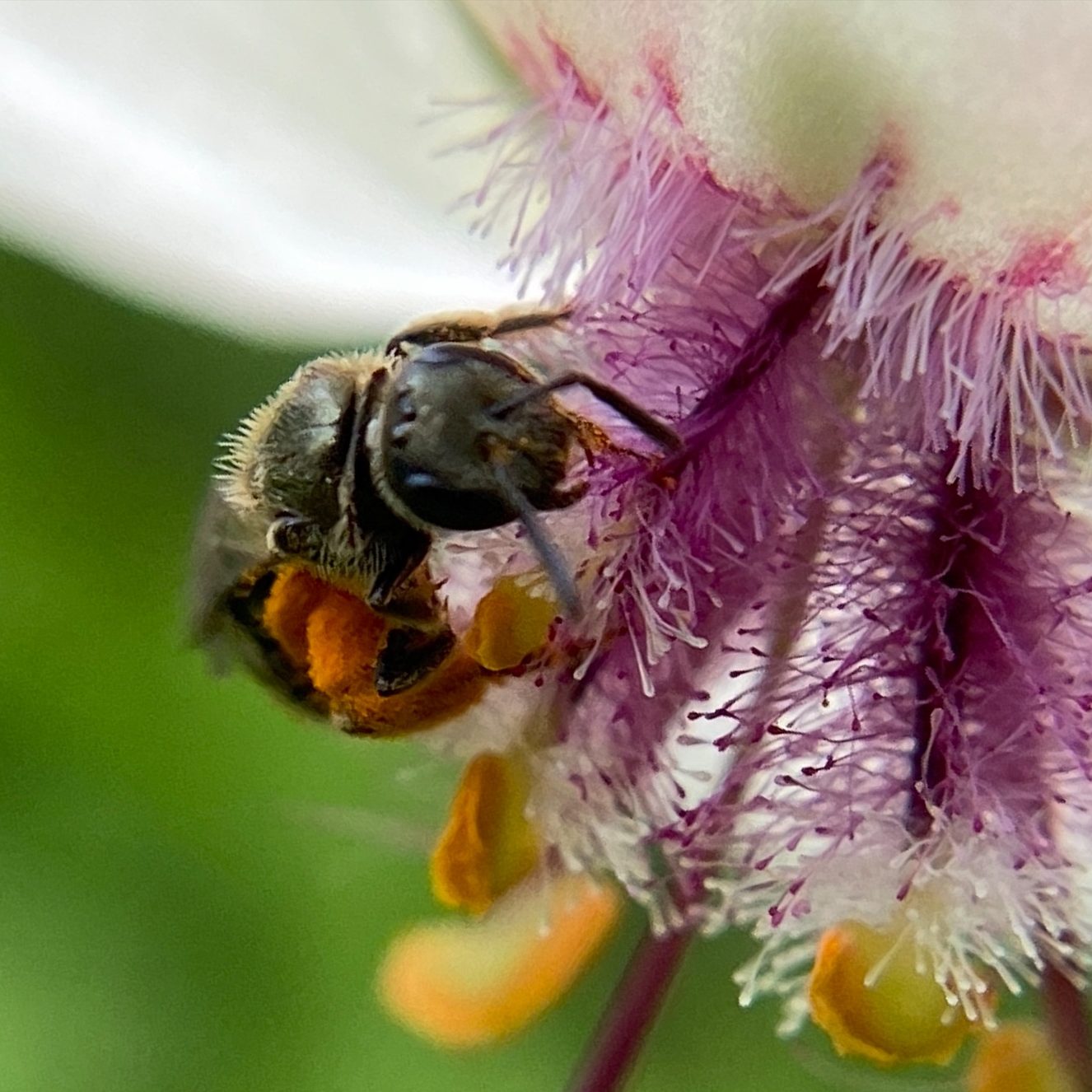
Think Like a Bee

  • Ordinary Bees

    These days, bees teach me about some timeless truths.  I thought I knew those truths, but they’ve become neglected and buried in me over the years. Now that I am without a job, having left good work that gave me much meaning and purpose over a decade, there is a decided urge in me to run out and replicate that experience. I want my life to unfold quickly. Pronto. No time to waste. Let me quickly get back in the saddle.

    But it’s not to be(e). In times of change and flux, much time elapses between resume′s cast out upon the wind like seeds and creative projects incubating.

    Yesterday I checked my bees. Tens of thousands of them, moving slowly, packed in a small hivebox, in the middle of a 64 F degree February day. They were not doing anything particularly spectacular. They were just eating and resting.  They were doing their usual…cleaning, guarding, feeding, gathering, communicating. The daily stuff of the hive. Just trying to stay alive together through the weird ups and downs of the winter weather.

    Theses words keep ringing in my head— from The Journals of Father Alexander Schmemann (Crestwood NY; St. Vladimir’s Seminary Press, 1973-1981) 284-85…“Get a job, if possible the simplest one, without creativity (for example as a cashier in a bank). While working, pray and seek inner peace; do not get angry…accept everyone as someone sent to you…pray for them”.

    I remember the days I worked full time. Sometime even the simple daily things such as meals were a hurried affair. Often they dropped by the wayside. I wanted to see results. I oriented my life around productivity. It focused me and kept me spinning. Despite my best efforts on the job, the lapsed time between the daily, ordinary things of life in community and the outcome of an idea or a project could seem astronomically slow. Life itself called me to slow down. But ‘Slow’ is not in my nature.

    Now it is required. I cannot push the river. It flows with or without me every single day. I can get in and swim awhile. But somedays the best I can do is just stand on the shore and watch the ripples. Or watch bees.

    Isaac Watson, the great English Christian hymnwriter (b. 1674) wrote:

    How doth the little busy bee

    Improve each shining hour,

    And gather honey all the day

    From every opening flower!

    I originally thought that this was a rhetorical ditty.  YES! See how bees improve each shining hour from their compulsive work of nectar gathering. And indeed, they are tireless, often frayed from long hours of fieldwork. But perhaps there is a question beneath this cheerful poetry. After all, how does the bee improve her shining hours..by gathering honey all the day long?

    Mark Winston, a bee biologist who wrote Beetime: Lessons from the Hive(Cambridge, MA: Harvard U. Press, 2014) found something remarkably different in his research:

    He said that bees in unstressed colonies are restaholics rather than workaholics,—spending up to 2/3 of their lives doing nothing (174) But, when required they can ramp up by compressing the normal time frame of work into a shorter more intense period…There’s an obvious lesson for stressed humans here, which is that rest may have an important relationship to our lifespan and provide resilience to respond to challenges in our personal, professional and community lives.(177)

    The key to how bees work is that they do many things during a lifetime, but they do them one at a time. Bees do one thing well for a period in their short lives, then move on to the next chore, accomplishing more efficiently through serial rather than simultaneous work (179) Bees work serially rather than by multitasking, an aspect of labor that provides an effective combination of specialized task performance and the flexibility to allocate the workforce where it’s needed. (177)

    We idealize people who multi-task and it makes us somehow feel better about ourselves. But in the end, evidently, Bees may not be intelligent, but they are single minded. Focus expresses the ability to concentrate…resulting in highly efficient and effective work. (180)

    Actually, I think bees have a different intelligence than how humans measure it. Intelligence is seen in the hive as a whole, not just one solo bee. Super stars are not useful. Every bee working for the common good is useful.

    So, as I live into this relatively unstructured time in my life, with much time for rest and reflection, i will continue to grapple with what it means to be focused. Single minded. I will continue to hear that little ditty singing in my head…“how doth the little bee improve each shining hour…”

    rlind_anitaamstutzbees_061215252


  • Tiny (bee) Adjustments

    Did you ever notice how just a tiny adjustment or shift can make a big difference in your life?

    On a freezing cold morning, sitting in an ever so slight ray of sun through a window, glancing on your back, the chill begins to thaw…

    A partner snoring on his back, keeping you awake, when gently poked, will roll over on his side, stop the sound and allow you to finally catch a whole night of sleep.

    For some, it’s just about as simple as getting up and putting clothes on to face another day.

    Or a conscious small shift in an old thought pattern, making a dark mood lift and the whole day look brighter.

    Recently a friend posted a wonderful thing on Facebook. A comic strip celebrating how the small, seemingly inconsequential moments in a relationship are really what build the foundation. Take a look at the beauty of mundane moments captured in comics..http://www.upworthy.com/24-relationship-comics-that-illustrate-the-beauty-in-the-mundane-moments?g=2&c=ufb1

    Bees teach me about incremental, small steps. Paying attention to tiny details. Mundane truths. They are all about this. Tending to that small stuff. Daily.

    My M.O. is often about getting the biggest and best results by throwing alot of resources in one direction. I like to see things change. Transformation.

    But bees are more subtle. They are tiny. The scale of what is best for them is often much different than my giant size requires. To think like a bee takes a regular readjustment in my brain.

    I’ve been known to overwhelm my bees with honey, in my eagerness to make sure they don’t starve this winter. If they need a little, then, by gum, 10 times as much should be better. Unfortunately, that didn’t work out so well. The colony had reduced, death likely due to varroa mite infestation,  and couldn’t absorb all that nectar of the gods. They were flooded and the honey dripped everywhere. Now they are plagued by ants.

    When I finally opened the door, one warm day recently, the pile up of bees inside made my heart sink. But suddenly, as I freed the door, a bee here and a bee there began to dart out and soar above the hive. Finally freed from their tomb of death

    These days, they hang out on the front stoop of their hive on any warmish day, sunning themselves in little gangs. I wonder what the news is from the hive. Are these the sole survivors? Is the queen alive? A hive can become as small as a fist and still survive. But they’ve gotta be tough. We shall see in a few months when I open the hive…

    Meanwhile, life has returned, merely by opening the door and sweeping out the dead bees. I’ve moved the hive into the full sun, so they can catch as many rays as possible, since the sun is like mecca for honeybees. It reorients them and warms up their cold blooded little invertebrate bodies. Maybe they will live after all.

    And I continue to try to learn the lessons of increments. Small steps. Tiny adjustments. Learning gratitude for the mundane and daily moments, even as I live into this vocational transition in my life. No external job or frame of reference for my ego.

    In these crazy times, when so much in the world around seems out of whack, it helps to stay tuned to the mightiness of the small in the humble honeybee.


  • Musings 0n Bees, MLK and Racism

    Racism is alive and well. On this day that we honor and celebrate the legacy of Dr. Martin Luther King Jr., I am reminded that we have only just begun. Racism lives in me and in the domination structures of our Western civilization as surely as I write this. Yet, we are blind to this fact. The hardest sayings by Dr. MLK, Jr. are mostly left unspoken.  Here is one:

    “The majority of white Americans consider themselves sincerely committed to justice for the Negro. They believe that American society is essentially hospitable to fair play and to steady growth toward a middle-class Utopia embodying racial harmony. But unfortunately this is a fantasy of self-deception and comfortable vanity.”—  Where Do We Go From Here: Chaos or Community?, (Boston: Beacon Press, 1967)

    The other day, my bees reminded me of how unaware I can be about the structures of colonization embedded in and around me.  It was a visceral lesson.

    I had just returned from a conference in Seattle, dealing with the direct results of racism and colonization (http://dofdmenno.org/). I went to feed my bees.  I am a colonizer of honeybees, you see.  Honeybees have been imported to this country over the centuries— from Europe, the Mediterranean, Russia, Latin America and elsewhere to fuel the New World’s agricultural machine. Over time, they have become the product of an industrialized model of agriculture. It is one that dominates, commodifies and eventually destroys the health of the very beings that provide the “fuel” for that machine. They become “throw aways”.

    Though I like to pride myself on being a small time “gentlewoman” farmer, a backyard, urban beekeeper who doesn’t purport to “industrialize” my bees—I am not immune to using and manipulating them.  I have been trained well by my culture to see nature and anything landbased as something to use to my advantage. I am out of tune. Alot.

    I opened the hive without any offering of smoke or the usual preparation of observing the hive, slowing down, listening to the sights and sounds around the hive before going in. Opening a hive is always seen as an invasive act. My hope was to dump in the latest sugar loaf, pour a little honey and be on my merry way. I was in a hurry. My intent was to move quickly and be done. I had my agenda for the day in place. It left only about 10 minutes for my bees.

    Needless to say, I was unprepared, impatient and careless. The hive exploded with thousands of bees—in my hair, stinging my hands, chasing me within an inch of my life.

    I dropped my food offering on the empty platter like a hot potato. It fell like a brick on the bees assembled there eating the crumbs. This further enraged the bees—their hive mates crushed. I felt miserable. Feeling attacked and awful after this exchange, I retreated to lick my wounds.  What happened, I wondered?

    Land based peoples, creatures and the land itself have been destroyed, “controlled” and assimilated as fodder into the industrial machine for milleniums. The push of western civilization to acquire, dominate and control resources and people has been done without reflection, critique or listening to the those whose lives and lands have been destroyed. Domination continues to this day in a host of “isms”—racism, sexism, ecoism, classism.

    These days I am thinking alot about race. Black lives matter is on everyone’s twitterfeed. Police violence, racial profiling, Muslim, Syrian and immigrant anti-sentiment are rife.   I am a white woman of privilege. Though I feel the vulnerability of sexism as a woman, my peoples do not have centuries of discrimination and destruction based upon color.  I have much to learn. Much to observe. Much to listen to and slow down until I can hear. I cannot right centuries of horror. I can only come awake and be present to ‘what is’ now.

    Another little known quote by Dr. MLK, Jr.: “Whites, it must frankly be said, are not putting in a similar mass effort to reeducate themselves out of their racial ignorance. It is an aspect of their sense of superiority that the white people of America believe they have so little to learn.”  Where Do We Go From Here:Chaos or Community?(Boston: Beacon Press, 1967)
    Waking up to this reality is painful. But wake up we must.


  • Hope for These Times

    We are now on the upswing…moving towards the light now that we’ve passed Solstice. I have been nursing along one of my weaker hives this winter. Trying to be helpful, I’ve flooded them with honey at times, the excess leaking out of the crevices of the hive. Dead bees also poured out with the honey, and I saw specks of varroa mites. They are in a bad way. The realization that they weren’t sucking down the sustenance I gave them, but rather most of it was dripping away, gave me the first inkling that something was wrong…I wonder what I will find when I open them up the first warm day of Spring.

    Beekeepers tend to be pragmatic about the life and death of their bees. Certainly in this day and age we don’t expect all our beehives to survive the winter. But the writing is clearly on the wall. Bees are in trouble. Last year 40% losses were counted nationwide. And that is far and above the usual winter die back.

    Sometimes a day in my beekeeping life parallels my feelings about what is happening in the world around me. My bees die. I grieve. Another mass shooting happens. I despair. Another racist act or comment…a chemical spill…a mine splits open into a river…an ugly political moment. And then I realize that I am focusing on the wrong thing.

    Clarissa Pinkola Estes writes in a 2003 article published under the title: “Do Not Lose Heart…” (Creations Magazine. December 17, 2015)

    …you are right in your assessments. The lustre and hubris some have aspired to while endorsing acts so heinous against children, elders, everyday people, the poor, the unguarded, the helpless, is breathtaking. Yet…I urge you, ask you…to please not spend your spirit dry by bewailing these difficult times.  Especially do not lose hope. Most particularly because the fact is—we were made for these times.”

    Pinkola Estes then goes on to lay out the merits of a seaworthy vessel, having grown up herself on the Great Lakes. She likens those who are awake and ready to endure these times as capable crafts in the water—setting sail on stormy seas. “Despite your stints of doubt, your frustrations in arighting all that needs change right now, or even feeling you have lost the map entirely, you are not without resources, you are not alone. Look out over the prow; there are millions of boats of righteous souls on the waters with you….when a great ship is in the harbor and moored, it is safe, there can be no doubt. But…that is not what great ships are built for…remember who you came from, and why you came to this beautiful, needful Earth[at this time].

    Wonder is everywhere. Lest I forget, I see the sun sparkle in a brilliant blue sky. I get to eat crinkly, fresh kale from someone’s winter garden. I smell the cedar hanging heavy in the evening air from someone’s chimney. I awaken from where I have snuggled with my tribe of kittens and husband at night, cozy and warm. I get up on my own two legs this morning and glide along miles of silent, powdered snow on skiis. Three out of four of my beehives appear to be kicking and very alive

    And so this day, this one beautiful day, I will keep the hope alive. And maybe the next day…

    rlind_anitaamstutzbees_061215157


  • At the Brink…

    AT THE BRINK..

    Brinks can conjure up frightening thoughts or imaginings of something exciting. Either way, it makes us breathless as we stand and look into the abyss, wondering whether we’ll free fall or fly.

    I stand outside my beehives in the bleak mid-winter, dead bees scattered at my feet. The temperatures plummet. This is the brink for a bee colony. If they are weakened by disease and mites, or don’t have enough food, they will die. I wonder which ones will be with me to welcome the warm  greening— the ancient Spring renewal and return of the nectar flow.

    rlind_anitaamstutzbees_061215290

    According to the western calendar, we stand at the brink of a new year, not knowing what is ahead. Mercifully the darkness enshrouds us. We cannot see. Maybe you are one of those people who welcomes the challenges of the new year…you are hopeful.  Or perhaps you are one who quakes inside at the thought of what might lie ahead.

    I think of that saying, which I remember from my high school graduating class of 1980…”What lies ahead is small compared to what lies within.”

    I have made resolutions in the past. These days, I leave such resolution making to those more resolute than myself. I want to be, rather, like the river, flowing effortlessly through the land. I pray to come to this half of my life with more faith, less resistance, more kindness.  Let my one tiny life be used, like the creekbed or the stream, to help carve out the contours of a sustainable future for the next generation.

    My ancestors who had gone before, left my generation with the gift of “enough”. We had land. We could grow our own food. We grew up knowing the expansiveness of summer night star shine, crayfish and willow lined streams, millions of fireflies twinkling over the cornfields, acreage of flora and fauna to roam. Life wasn’t idyllic, but it was enough. I was blessed to experience the intact beauty and grandeur of life on planet earth as I traveled and slept next to glaciers, in national parks. I roamed African grasslands, thick with zebras, ostrich and hyena— places of people and creatures not yet disappeared.

    Yet, I and subsequent generations will not have access to land. We have moved to cities. We don’t have the financial wherewithal to preserve the land from development. Yet all is not lost. We can become the  guardians of our own local habitat. Start small. The stream, that ditch, a piece of land, our yard, a tree, wild creatures, beehives in our rafters, wasps in old logs. All of these—our neighbors. These intimate places around us are threatened, eroded and destroyed daily. Pay attention. Take care.

    We are at the brink of something that we haven’t faced before as humans. The population on planet earth surges.  Hundreds of thousands of species are extinguished by generations of care-less fossil fuel guzzling lifestyles —pollinators are on the short list. Global Climate change is making the news daily. I grieve indigenous people and their homelands raped and plundered, even today, by mining and fossil fuel interests. I rage at those Big Ag interests that are industrializing and objectifying animal husbandry and destroying our precious soil and water with chemicals and GMO’s. I am sickened by roughshod development, destroying habitat for all creatures.

    Still.  We can all do our little part. Still. We can all hold close to our hearts all that is dear and sacred, all that is living and breathing in our time. Our loved ones can expand to include trees, coyotes, topsoil, beautiful rivers, butterflies and bees.

    As I write this, I celebrate that my new non-profit has been birthed!  Her name is “Think Like A Bee”. The mission is to advocate and educate for healthy bees and pollinator habitat— and this is not just for the birds (and bees), but for us humans to have healthier habitat as well. Food that is increasingly free from harmful stuff like GMO’s and chemicals. I leave you with a small story from my PeaceMaking Day by Day book(Erie PA: Pax Christi, 1985)…the source of this beautiful story is unknown.

    God decided to become visible to a king and a peasant and sent an angel to inform them of the blessed event.

    “O King”, the angel announced. “God has deigned to be revealed to you in whatever manner you wish. In what form do you want God to appear?”

    Seated on his throne and surrounded by awestruck subjects, the King proclaimed, “How else would I wish to see God, save in Majesty and Power? Show God to us in the full glory of Power.”

    God granted his wish and appeared as a bolt of lightning that instantly pulverized the King and his court. Nothing, not even a cinder, remained. The angel then manifested herself to a peasant saying; “God deigns to be revealed to you in whatever manner you desire. How do you wish to see God?”

    Scratching his head and puzzling a long while, the peasant finally said, “I am a poor man and not worthy to see God face to face. But if it is God’s will to be revealed to me, let it be in those things with which I am familiar. Let me see God in the earth I plough, the water I drink, the food I eat. Let me see God in the faces of my family and neighbors.”

    God granted the peasant his with and he lived a long and happy life. May God grant you the same!

    Blessed New Year!


  • Welcome Solstice

    As the bees hover suspended in their sleep, tucked away from the snow and cold, dreaming of the Spring cherry blossoms, we too are invited to slow our ever increasing speed and rest. We are called to inhabit the darkness and let it midwife our souls into a deeper peace, a larger reflection of our lives…

    If you haven’t heard the Bee Carol by Carol Ann Duffy, featured by Garrison Keillor on Dec. 20, 2015, listen to the poetic magic of this ode to
    • winter bees
    • <b>Winter</b> <b>Bee</b> Cluster

    As you prepare to enter a New Year, I offer you a prayer and a wish that you may “bee well” in all ways…from the Psalmist (paraphrase of 114)

    Come, all you who have wandered far from the path, who have separated yourselves from Love; A banquet is prepared for you in the heart’s Secret Room.

    There you will find the way home; a welcome ever awaits you! Even as you acknowledge the times you have erred, the forgiveness of the Beloved will envelop you.

    Call upon the Beloved when fear arises, when you feel overwhelmed; The Eternal Listener will heed your cry; you will find strength to face the shadows.

    Befriend all that is within you, discover the Secret Room in your heart. Then will abundant blessings enter your home; and, you will welcome the Divine Guest who is ever with you.

    (Psalms for Praying: An Invitation to Wholeness, Nan C. Merrill (NY:NY, Continuum International Publishing Group, Inc)

    May we all find that Secret Room for silence and restoration in this season of darkness and cold in the Northern Hemisphere—like the inner chambers of the beehive. Huddling close for warmth.  May the beauty of our collective souls radiate and glow this Solstice, like a candle in the night, seeping into all the corners and cracks of a hungry world. Let us all imagine this place we call Earth, healed and whole. A place of beauty, peace. Enough for all.


  • Mean Times

    These are mean times we live in. It reminds me of Charles Dickens’s opening lines in A Tale of Two Cities, ‘It was the best of times, it was the worst of times

    Despite meanness, life affirming work continues to squish up through our commonwealth toes. Global grassroots organizers like Ruth Nyambura, a Kenyan political ecologist; and Kandi Mossett, an organizer with the Indigenous Environmental Network in North Dakota balance out begrudging world leaders on Climate Change action.  Fresh faces like U.S. Bernie Sanders and Canadian Justin Trudeau’s “sunny ways” politics balance out the cold war, fear mongering political attitudes of a tired, old WWII bunker paradigm.

    What do bees have to do with this?

    IMG_0357
    A peek inside the hive at my hibernating girls on a 60 degree day last week..

    Bees speak to us of the kind of collective activity and flurry of coming together for survival sake which must happen in these mean times. Such times, by the way, are also rich with opportunity. As big and angry and ugly as the the death dealing, fossil fuel and global banking industry remains, much bigger is the voice and heartbeat for life— in all it’s many manifestations of health, whether creaturely, plant or human.

    As Mark Winston, biologist, beekeeper, and Academic Director of the Centre for Dialogue at Simon Fraser University, wrote in BeeTime: Lessons from the Hive (Cambridge, MA: Harvard U. Press, 2014)p. 17:

    If there is one notable message from honeybees, it lies in the power of their collective response to stress, in the way they allocate work, communicate, make decisions, and balance individual activities with their communal imperatives. Our decision either to emulate honeybees by opting for the collective good or to pursue personal interests and individual gain may be the decisive factor in the success or failure of our response to contemporary environmental challenges.

    IMG_0358
    feeding my bees honey, since nectar was scarce in the late summer and fall 2015

    These days my bees huddle together for warmth, in a football sized ball. Collectively they slowly rotate from the inside of the ball to the outside, taking turns in the center of the warmth. The babies and queen stay at the center all the time and the goal is to keep the future generation from freezing to death. Bees emit heat by vibrating their flight muscles together, keeping the ambient temperature at around 98 degrees F. During the winter they will slowly eat through their honey and pollen stores.

    They are tens of thousands of ordinary bees. Most will not live out the winter or see the next Spring come.

    In the end, it is going to be millions of ordinary human beings that bring about the change needed for this generation.  The social transformation that is needed now to contain the odious threats of Climate Change will ultimately be driven by ordinary citizens like us. We are the ones who must move us from Mean Times to Kind Times, from Ignorance to Wisdom, from Industrial Fossil fueled steroid injected lifestyles to Earth balanced, respectful, Eco-centric ones —for the commonwealth of the whole biotic community.

    I will end with a brilliant quote by Rabbi Marc Gellman, spoken at the Yankee stadium on September 23, 2001, in the wake 9-11. Entitled “We are Unbreakable”. My bees know this inherently.

    The Talmud and the African tribe, the Masai tribe, both teach a wisdom for our wounded world. They both taught:

    Sticks alone can be broken by a child, but sticks in a bundle are unbreakable.

    The fears and sorrows of this moment are so heavy, they can break us if we try to bear them alone. But if we are bundled together – if we stick together – we are unbreakable.

    And we shall do far more than merely survive. We shall overcome. We shall overcome the forces of hatred, without allowing hatred to unbundle us. We shall overcome the forces of terror, without using fear to unbundle us.

    So in all our comings and our goings, from this time forth, let us remember: That the person next to you, in front of you, behind you, is not merely an obstacle to your free and unfettered life. They are a part of this bundle, that keeps you and each of us from breaking.

    Let us never again view our fellow New Yorkers, our fellow Americans, our fellow citizens of the world, (I would add, our fellow creatures and biosphere)as limitations on our life or freedom. But rather as the moral twine that binds us, and saves us, and delivers us from evil.


  • Spiritual Re(Bee)silience


    My bees are confused. This winter, in a year of the warmest global weather trends on record, they go to hibernate as the temps drop nightly to 20 degrees F. But then the next day is 50-60 degrees and sunny. My girls are eager to come out and begin the search for food. Unfortunately the trees are barren, the pollen is gone. Spring is months away. They burn up precious honey stores as they fly around in mid-winter, doing their usual foraging. I continue to feed them.

    Global Climate Change is real.

    I’m not sure flying hundreds of thousands of people to Paris, burning millions more gallons of fossil fuel en route, was the best way to address the heating of the planet through carbon emissions.

    Perhaps if everyone had stayed home and had a giant skype party to plan the next step, we’d be a bit further ahead. Maybe it could have bought the Marshall Islanders an extra year reprieve as their home slowly sinks into the rising ocean.

    Honeybees are only one indicator that our atmosphere is changing and warming. Some creatures have already begun to migrate to northern most habitats. Plants and trees that have been Keystones in southwest climates for a millenium are dying from drought and disease. They are being replaced by desert terrain, other flora that is non-native or not co-evolved with the local pollinators.

    In these times of unpredictable weather patterns, massive extinction and human carbon activity, as we wonder what another year will bring—never mind a decade—soul resilience is needed.

    Llewellyn Vaughn-Lee, Sufi Teacher, For Love of the Real (Fall 2015), sees strengthening our spiritual resilience in these times as critical. It is as important as adapting our physical lifestyles to a less impactful, destructive, consumeristic way of being. As he wrote from COP21, the Global Climate Summit in Paris: “Paris, A Spiritual Response to Climate Change” (Huffpost, Dec. 2, 2015)

    “[we must do] small things with great love, learning to live and act with love and care, with the true attention of our minds and hearts—these are the signs of the sacred and the truest way to generate life, to help life recreate itself.

    The forces of greed and exploitation are more entrenched than we realize, the environmental collapse accelerating, but this is the challenge for those whose hearts are strong, who care for the planet and for the souls of future generations.

    The bees teach me to think small, act local, go native. Their little lives of 30-45 days are all spent in the neighborhood, foraging, feeding their large families, staying healthy, building their economies of honey, pollen and wax comb. Working collaboratively, they scour the weediest, most humble habitat, spinning dandelions, chamisa and goatheads into pure golden honey.

    As our communities will be shaken with new challenges from climate change in the coming decade, we will need the same community minded intelligence and resilience of bee colonies. Caring for one another and seeking the highest good for the whole commonwealth—human and non-humanwill be our biggest learning curve. Transcending tribalism and opening our hearts to include the bee, the Syrian, the soil, the “other” will make us spiritually resilient.


  • Funeral Bees

    Recently I shared this post on my facebook page, swiping it from another friend’s page (thank you Lynn!). It was a little clip from the Danville Bee, June 4, 1956—a story posted about a swarm of bees attending their keeper’s funeral in Adams, Massachusetts.

    Throughout his life, John Zepka had raised, worked with, and loved bees. He became widely known in the Berkshire Hills as ‘a man who had a way with them’. “

    According to the article, as the funeral procession approached the tent they found it swarming with bees. Clinging to the ceiling and floral sprays, the bees weren’t there to harm anyone. They were there to bear witness to their beloved keeper’s life and death. They were merely showing up along with the other mourners to give their solemn regards.

    493da-bees

    It brought to mind the old tradition of “telling the bees”….that when a member of the family dies, the bees must have their hive draped in black cloth, lest they leave for good. As one northern European song goes:
    Honey bees, honey bees, hear what I say!
    Your Master, poor soul, has passed away.
    His sorrowful wife begs of you to stay,
    Gathering honey for many a day.
    Bees in the garden, hear what I say!

    (Ethnobeeology, Nov. 13, 2013)

    I share this story, along with last week’s post, because I am fascinated by the intimate connection that we are able to have with the natural world.  We’ve noticed it with bees, because they are among the few creatures with which we’ve cultivated a relationship—for over 5,000 years. Since I’ve begun to have a relationship with bees, I’ve paid close attention to their habits, changes in their behavior and housekeeping patterns. When I lost both of my hives last winter, I cried. Spring blooms were not the same without the busy, buzzy beehives in my backyard. For me they signal life and the passing of seasons. I certainly mourned their passing. I’m not sure they would mourn mine.

    As a bee colleague of mine once said, “I don’t think a few years of having bees qualifies one as keeping bees”. I would concur. One must spend a lifetime of care and dedication to nurture such a bond of trust, as John Zepka’s funeral bees illustrated.

    We have many miles to go in our relationship with the world of wild creatures.


  • We Are Giving Thanks

    IMG_0017

    I like to collect bee stories.

    This past week I went to see my friend Diane for Acupuncture (https://www.facebook.com/search/top/?q=Mother%20of%20Mercy). Diane is not only an amazing curandera, but also a devout Catholic dedicated to intercessory prayer on behalf of those who suffer —not only for humans but all living beings. She understands the one-ness of all creation and the vast web of life that we live within, sacred and blessed by the Creator.

    As often happens, we got to talking all things bees. Diane told me this story which she said I could share…

    This past summer, she noticed that the vegetables she planted in her back yard were devoid of bees. She worried. She waited. Not a bee in sight.

    So she began to pray for the humble busy bee. She asked for the bees to come and visit her garden. And knowing Diane, with a heart filled up to overflowing with gratitude, she gave thanks to God for the bees.

    Later that day, her husband Buzzy called her, saying, “Diane, did you see your tomatoes? There are bees everywhere. Lots of them”. (I am liberally paraphrasing her husband’s words.).

    Sure enough, when Diane returned home that day, she said there were not just a few bees, but swarms of bees!

    This week many of us will give thanks around our tables with family and friends in our traditional holiday style.

    I bow to the First Peoples of this county who, out of their great and generous hearts, prepared food for the European settlers those many centuries ago—struggling with disease and hunger on the shores of this land. How could they know that the white men would flow into this country like hordes of grasshoppers over the next centuries, decimating their land, their people, their way of being?

    I bow to the refugees today, on the move from their lands because of the violence of war, the seizing of their land, the inequitable global economics.

    I pray that we might awaken to the same Spirit of connection that Diane reminded me of this past week— we are part of a vast web of life, human and nonhuman. May we live and pray to be in sacred relationship together, honoring all life. Honoring every being’s right to live kindly, peacefully and fruitfully upon God’s good green earth.

    To end this post,  I am shamelessly copying W.S. Merwin’s powerful poem, “Thanks“, even as we stand in the face of so much that has been taken. So much that is lost. So much that is beautiful. So much that is possible…

    Listen
    with the night falling we are saying thank you
    we are stopping on the bridges to bow for the railings
    we are running out of the glass rooms
    with our mouths full of food to look at the sky
    and say thank you
    we are standing by the water looking out
    in different directions.

    back from a series of hospitals back from a mugging
    after funerals we are saying thank you
    after the news of the dead
    whether or not we knew them we are saying thank you
    looking up from tables we are saying thank you
    in a culture up to its chin in shame
    living in the stench it has chosen we are saying thank you

    over telephones we are saying thank you
    in doorways and in the backs of cars and in elevators
    remembering wars and the police at the back door
    and the beatings on stairs we are saying thank you
    in the banks that use us we are saying thank you
    with the crooks in office with the rich and fashionable
    unchanged we go on saying thank you thank you

    with the animals dying around us
    our lost feelings we are saying thank you
    with the forests falling faster than the minutes
    of our lives we are saying thank you
    with the words going out like cells of a brain
    with the cities growing over us like the earth
    we are saying thank you faster and faster
    with nobody listening we are saying thank you
    we are saying thank you and waving
    dark though it is

    — From the Rain in the Trees, copyright© 1998 by W.S. Merwin.

    (I hope I will be forgiven for transgressing any copyright rules, despite the fact that this poem is linked everywhere on the internet…)