-
Cross Pollination
There is currently an amazing exhibit at the 516 Arts Building in Albuquerque,New Mexico @ 516 Central Avenue downtown. It will be there through November 1, 2017.

If you haven’t made your way down there, you must.
Valerie Roybal, visionary artist, is also an Albuquerque backyard beekeeper. She gets it. The beauty, the mythology, the symbology, the historical importance of bees then and today.
Through music, art, jewelry, sound, Valerie takes us into the intricacies of our human interconnection and intersection with the world of beneficial insects.
Interspecies communication is a new buzz word. It implies sharing and understanding information between two or more species that work towards the benefit of both species . This exhibit reveals this lovely interdependence. Finally humanity is waking up to this.

Here’s what she writes:
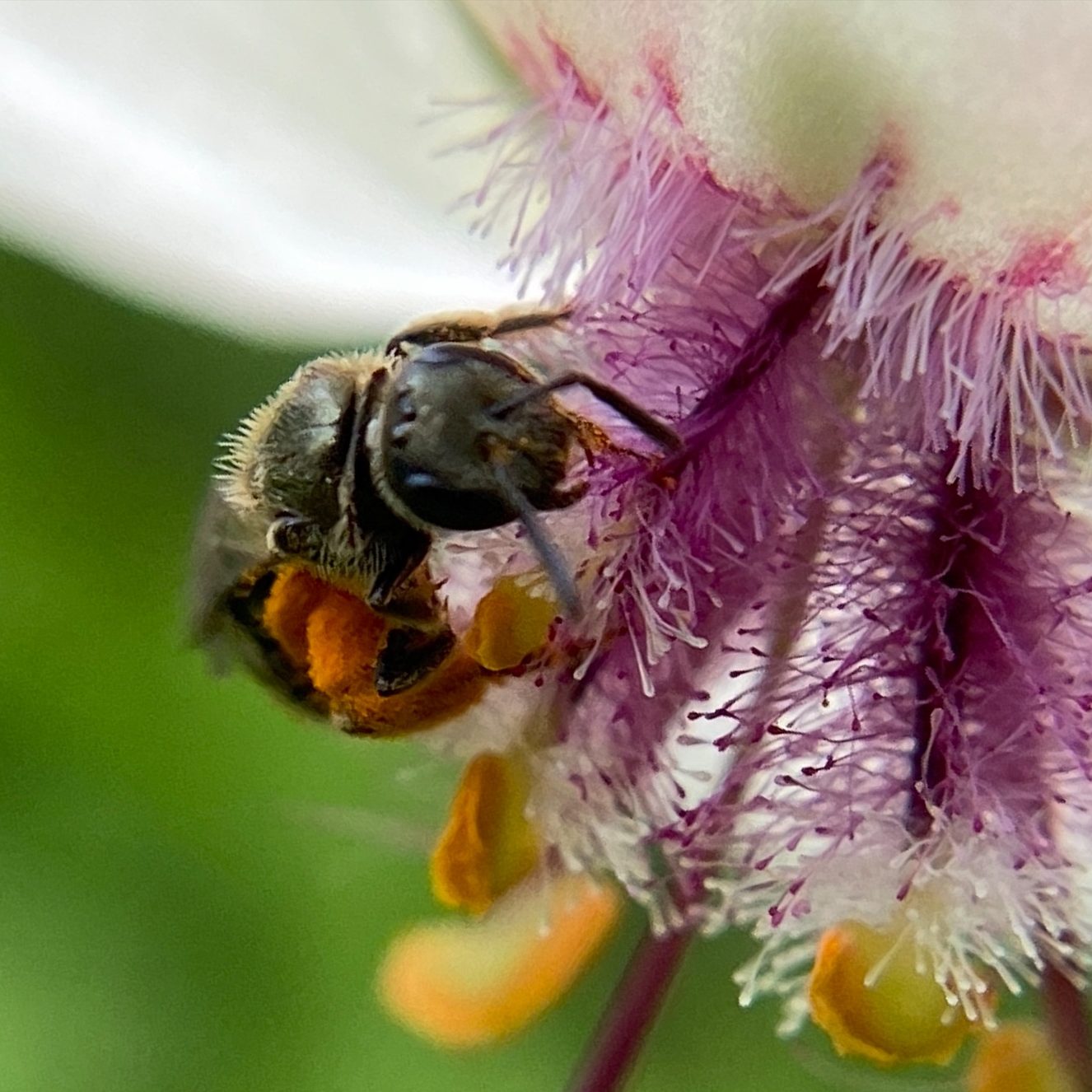
An exhibition at the intersection of art and science, emphasizing the importance of bees and other pollinators…

If you didn’t already fiercely love the insect world, I hope this will be a step towards awe and admiration.
Plan to go soon.

-
Water is life II

Fracking Rio Rancho, the meeting to determine which would prevail: the Stoddard Ordinance, written for the oil and gas industry, or the Citizen Ordinance, written for public safety, went like this…
The September 21 Sandoval county commissioner’s meeting was not only flawed, it was a sham, a farce, a public shame. An unpaid, well informed, educated and reasonable citizenry showed up on their own dime to present their concerns and well researched and thorough findings on geology, hydrology, fracking pollution, corporate regulation, diversified energy economy and public health. It was not lost on these good citizens that the front row seats were reserved for well heeled, connected oil and gas industry representatives, while 75 persons who came to comment against the Stoddard ordinance were barred from the too small room, and sent packing to view this on the 2nd floor monitor.
The overwhelming majority gathered that night were clear with their elected officials. The Rio Grande/Chama Watershed, this limited ribbon of water serving the food shed, agricultural hub and residential neighborhoods of over a million people downstream, could be irreparably damaged by fracking. The public was rightfully appalled that our leaders have not held this sacrosanct, and protected from the insanity of any industrialization by the profit driven, poorly regulated fossil fuel and mining industries. The Stoddard ordinance may allow for this, but is it moral for elected officials to endanger the watershed of a million or more people?
At the end of a 4 hour meeting with impassioned citizen testimony, the chairman read a pre-written statement that clearly stated what he knew before we began— that ordinary citizens would have no impact or bearing on the final decision. The Stoddard Ordinance would stand. All, save one, would vote yea, revealing that they operate as a corporatocracy, not a democracy, using the thinly veiled guise of “jobs” though the community knows there are safer ways to economically diversify and create good jobs. The process may have invited public comment, but it was clearly disregarded by a preemptive decision. Is leadership ethical when its decision is clearly weighted before the process even begins?
Perhaps those commissioners who claim to be public servants, yet voted for the Stoddard ordinance, written to benefit the oil and gas industry, would want to begin by sacrificing their mineral rights and live within the allowed 750 feet next to the first fracking well?
The public, including the Pueblo’s sovereign governments, deserve a real forum. Citizens demand a thorough process by non-corporate true public servants who will actually do meaningful environmental reviews on water, air quality and infrastructure in response to this amoral request to frack the Rio Grande watershed.
Without clean water, future generations—from pollinators to humans—will not survive. Here in the drought ridden high desert of New Mexico, it’s not even so much the choice between clean water or polluted.

It is whether we will have water.

-
Water is Life
Fracking has come to many of our backyards here in central New Mexico. Rio Rancho and Sandoval County commissioners are getting ready to pass a fracking project without citizen consent. Follow the money. Apparently it speaks louder than the people.

Time to stand up for our water. Water is irreplaceably precious.
Here in New Mexico, everyone lives downstream from someone else. Our lives are tied together by a ribbon of life—the Rio Chama watershed— and a series of rivers and aqueducts refueled by snow pack. All are threatened by drought, development, agricultural and industrial run-off and overuse in the land of enchantment. The Rio Grande River runs out of water somewhere in the desert of Southern New Mexico. It never makes it to Cuidad de Juarez, Mexico. It is an ongoing feud.

Curiously, those who make the big bucks in the fossil fuel industry and those in office who benefit continue to ignore the lesson that includes them—when the clean water is gone we cannot drink oil.

Without ordinances that keep these projects out and strictly prohibited, we will be living with the sickness of air, land and water pollution in all of our backyards. Water is heavily used to “clean” and process oil and fracking gas. In a drought ridden state there is precious little water to spare for processing the heavy metals and chemically laced natural gas pumped out of our water tables to the tune of millions of gallons of water.
Meanwhile, the oil and gas industry, which has been in New Mexico for over half a century or more, continues to swindle the public and pump money into protecting their interests. In the land of endless sunshine, there is a battle brewing for dominance of the energy future. And the citizens want clean energy. Don’t be fooled. Natural gas is NOT clean energy. Solar, wind, geo-thermal, bio-mass and many other forms are the future.
If we learned nothing else from Standing Rock, it was that water is life itself and it is worth standing up and fighting for. I am thankful to all Indigenous brothers and sisters who came together with the Sioux nation to teach us.
Click here and I will share a recent letter I sent to multiple local papers of which a portion of this was picked up by the Albuquerque Journal. Here’s some of the places to send your letters:
I invite you to flood the media and offices of these commissioners and pass this along to friends and family, neighbors, workplace and organizations. As down -river dwellers our health will be irreversibly impacted by fracking. Ask the Navajo nation in the Four Corners. They live wrapped in a Delaware size cloud of methane from off-gassing by the fracking industry.
Commissioners are located in Rio Rancho at the county seat at 1500 Idalia Road, Building D, Bernalillo, NM 87004 and here is the mailing address: P.O. Box 40 Bernalillo NM 87004 and phone #505-867-7500 Fax# 505-867-7600
This is our moment to stand up for New Mexico water. Your water. Our water.
Water is life. For all living beings.
Mni Wiconi.

-
Needed: Young Farmers
Please apply.
Evidently, arable land is shrinking and the average age of farmers is about 57 years old, with 1/4 of farmers over 65. That’s not good news for tomorrow’s food.
The Rio Grande Community Farm is an incubator for new farmers. According to Sean Ludden, Executive Director, this year’s batch in the Las Huertas farm training program were women. We mused about this at the last Albuquerque Community Foundation meeting. Why are women coming in droves to shore up farming—a quickly diminishing vocation? The same holds true for beekeepers. More women than ever in this formerly male dominated field.
Perhaps it is because women are generally the gatekeepers for the well being of their children, the family and community. No surprise that they are being drawn into the profession of tending small plots of land and the husbandry of animals. They want a healthy food system.
We need less industrial farming and a war sized effort of expanding small farm — employing boatloads of people, not one or two old men at the helm of massive farm machinery in air conditioned cabs.
We need less square acreage of animal feedlots, dumping methane and the stench of suffering into the air, and foul waste into the water tables of communities.

Satellite view of a feedlot 
Cows packed in feedlots for miles in Dalhart, Texas We must vote with our dollars when it comes to food—avoiding the cost of so much environmental, animal and community suffering. We need to support small farmers.
The Environmental Protection Agency (EPA) said this, back when they were not villianized by Washington D.C.:
[The] growing scale and concentration of [Animal feeding operations] has contributed to negative environmental and human health impacts. Pollution associated with AFOs degrades the quality of waters, threatens drinking water sources, and may harm air quality.
My friend Deb is a case in point for the new face of farming. Unexpectedly she, as the daughter of a farmer, was the one who took over the family farm. Not a son. Deb’s facebook posts nourish me. I love visiting her farm via facebook! Her place is full of the beauty and the living experience of real food. Village Acres Farm and Foodshed is all color. Robust health. Organic and life affirming. It is full of animal whisperers.
Here’s a recent post:Or this:
Lovely morning spent in my pepper sauna!

See what I mean? This is what #realfood looks like. And everyone on the planet should have access to this. Not the dead stuff, devoid of vitamins and minerals, grown from depleted GMO saturated, fertilizer and chemical ridden soil whence most food hails.So, if you know an entrepreneur, itching to get their fingers in the soil, but need support and a piece of land, send them to Sean Ludden at Rio Grande Farms.They aspire to to launch farmers from college to middle age into a new vocation!
-
Real food

I am putting in a plug for my farmer friend Lorenzo Candelaria, whose land has been in the family for over 300 years. Every day, he and his crew cultivate, tend and harvest beautiful organic food to eat. It is the food that comes to us gratis from bees, soil, sun and water. He offers CSA (community supported agriculture) boxes. Cornelio Candelaria Organico hand delivers to your door. Who does that these days?
Not many people know about his small farm, tucked away in a corner of the South Valley, Albuquerque. Most farmers tend small plots. Lorenzo has 4 acres. Like many farmers, they produce massive amounts of food—way more than they can even sell or give away. Mama Earth is like that. Abundant. Productive. Prolific. Especially if you treat her right. If mama ain’t happy, ain’t nobody happy.Lorenzo is a mystic farmer. He has a special connection with the land and understands that our human dependence on mother earth is like an umbilical cord. It is a sacred, nourishing relationship. We humans cannot live without her generosity. Yet, unlike a baby in the womb, Mother Earth requires our mutual care. Under Lorenzo’s tending, Mother Earth flourishes. She is happy. So are my bees that live on his farm!

Lorenzo and Dora have space for more CSA box customers. Fresh produce to your door every week, or however often you want to receive one.
Sign up for gastronomic delights and joyful foodie journeys, week by week. Call Dora or Lorenzo today 505-382-5447.
-
Low Fertility
Seems that bees are in trouble on more than one front. If mites don’t get them, infertility will.
This past year I’ve had an alarmingly low rate of healthy mated queens. I’ve made some mis-steps and a few decisions to split a hive a bit prematurely, but either way, the virgin queens I put into the hives came back with poor to no ability to lay eggs after mating (or not) with drones. They looked perfectly beautiful and healthy. But they were laying nothing at all or only drones. A hive will quickly die without it’s worker girl bee force.

Low fertility in the human world is not so different from other species. I’ve read that when the survival of species are threatened, certain evolutionary mechanisms will kick in to effectively curtail reproduction. God knows, humans and all creatures are faced with dire threats to life these days—generations to come are facing massive problems which would cause fertility problems in any being. External factors that influence internal include habitat that is compromised by threats of increasing climate unpredictability, stress, polluted environments leading to poor health, immune problems, genetic defects and inability to create a healthy fetus.
Bees will die due to “a thousand small cuts”— coined by Mark Winston, in Bee Time, Rather than one pinpointed catastrophe, it’s the multiple and cascading issues which are dooming bees to extinction. The domino effect. Could it be happening with humans also?
I began to research what other beekeepers are saying about sperm counts and mated queens and fertility in the bee world. What do the old codgers say? What do the veteran beekeepers know? This blog post— from Roger Patterson, who keeps bees in the UK— hit home:
I started keeping bees in 1963 and at one time had 130 colonies, and have always raised my own queens on a regular basis. For a number of reasons I had a spell where I had no bees myself for about 15 years until restarting in 2002, but retained interest in my local Association, and continued to attend meetings. At one stage I could expect a success rate of getting queens mated from a sealed cell well in excess of 90%, but since returning to active beekeeping that success rate has dropped alarmingly, in my own experience to 50% or less.
When restarting I obtained 5 colonies from various sources and rigorously culled the poorer queens. In doing this I realised there was a problem in achieving the level of successful matings I had previously enjoyed.
In the Dec 2004 issue of BBKA News I wrote an article on my experiences, and asked if the problems were related to varroa[mite]. I received several replies and these fell largely into two groups, those who had kept bees for around 15 years or more, and agreed with me that there was a problem, and those with less experience who indicated that my experiences were “normal”, which is understandable if that is all they had known. One person who regularly raised a large number of queens appeared to have a success rate as low as 15%.
I received references to research work that had been done abroad, and there were indications from what I considered to be reliable sources that varroa and it’s treatment may be a contributory factor, and in a variety of ways.
Drones that were parasitised by varroa as larvae may have reduced sperm and lower viability if, indeed, they managed to survive to sexual maturity, and it appears that some treatments may accumulate in beeswax, and possibly cause the following problems:-
- Reduced sperm count in drones.
- Reduced queen mating success.
- Reduced queen weight.
- High queen mortality.
- Physical abnormalities in queens.
So, varroa mites. The culprit in almost every aspect of collapsing colonies these days. These creepy, draconian specks of a beast are destroying bees. And we as beekeepers stand by almost helpless, watching the demise of our bee colonies.

I will be treating my bees this year. Sometimes it seems the treatment is more deadly than the disease, kind of like chemo for cancer.
But it must be done.
God save the queen.
God save us all.

-
Dancing Moon Woman

The sun went all shadowy today.
For at least 3 minutes
the flames of
Too much bright
Too much heat
Too much “big man” war energy
and posturing
Eclipsed
By the lunar face
of the feminine moon
and her traverse across the sun.
Sun was eclipsed for a moment
Missing in action.
Healing dark
Secret womb energy
Fierce bone circle
A messenger from the night
Grabbing our attention
In the middle of our day’s
Freight trains of busyness.
Maybe she is birthing
Something new
Exposing our shadow side
Covering the frenetic
Flames of a culture
Burning down
From its hubris
Of earth rape
Plunder
Greed
Power
Racism.
All the “isms”
Emptied out
for a moment by
Dancing moon woman’s
Mercurial
Powerful
Gravitational force.
Usually only waxing
And waning
In cycles
During our dream time.
But here she was
moving across the sun’s field
A marriage of light and darkness
In full view
Maybe a shift took place this day
From a human epoch
Bankrupt in its excess
and imbalances.
Maybe a new consciousness
Took root
For an age of authenticity
No more illusions.
I sat on a hill in Northern New Mexico
among the sage bushes
and Fall flowers

a stunning display
of Autumn’s glory
At least 15 varieties
Crowding
Around my feet.
I felt the the moon
Dancing,
Her eclipse
Seeping
Soaking
Into the fiber
of my being.
Her moon dance
Felt
Not so different
From the bee dance
That vibration of happiness.Aliveness. -
Bumblers and Other Fancy Bees

Native Bees number over 4000 in the U.S. alone. Six of the major families of natives live in New Mexico—including bumblebees, bombus terrestris. These native bees, from a few millimeters long to the stout bumblers, are sadly overlooked. They aren’t viewed as the food economy’s workhorses. Instead, honeybees have become the new movie stars, hailed everywhere they go. Honeybees have been good poster children—signifying everything that’s gone wrong with our industrial food system and chemically burdened planet.

But native bees….these little pollinator dynamos are worth learning about and attracting to your garden. Now that honeybees are collapsing, these self sufficient, independent native bees have caught the attention of the commercial food industry agriculture, especially almond growers, alarmed by the disappearing honeybee.
I get my share of worried homeowners wondering if I can come over and pick up their bumblebee hive. I would if I could. But beekeepers are specialists in apis mellifera (well, we think we are), not bumblers. I can pick up a honeybee swarm since i know their docile nature when they swarm. But bumblebees, or so I’ve heard from first hand encounters by beekeepers, are a different beast all together. They do have a colony, usually found in an underground burrow. If they are too close to human activity or animals they may become aggressive and protective. But usually, if far enough away from the action, they will just mind their own business.

But I would never ever in my right mind try to remove one. They do sting if aggravated, and the sorry bloke who tries to dig them out will not fare very well at all. The good news is that the colony completely dies back each season. The queen will lay her next years brood of queen eggs to replace herself. But the rest of the workers are toast. If you really don’t want them to set up residence in your backyard, I usually counsel covering up the hole, after it gets cold and goes dormant, and putting a cover, rock, boards, etc. over it. Any emerging queens in the Spring will likely find another home for their brood.
But don’t take my word for it. Call your local Cooperative Extension service. Here in New Mexico, check out the New Mexico State University in Las Cruces. Ask their specialist about native bumble bee behavior. With all native bees in decline, killing them has become a non-negotiable. Don’t do it.

Most native bees are solitary creatures. There are the yellow faced bees, squash bees, digger bees, long-horned bees, mallow bees, cuckoo bees, carpenter bees, plasterer bees—all with special and unique abilities. See my June 2016 blog post on all the amazing varieties of native bees, of which over 1,000 of them live in New Mexico alone. The first remarkable thing about native bees is that they live in the dirt, in excavating tunnels that can reach a foot or more beneath the soil, in dead wood or hollow plant stems, plugging the entrance with mud or other chewed plant material after laying their eggs in unexpected places that humans don’t expect to find bees. So leaving undisturbed areas in your lawn, or buying a native pollinator house (google it) will ensure that their progeny continues. The biggest threat to native bees is the use of chemicals and insecticides on dirt and on your plants, and loss of habitat. These lovely little natives have co-evolved with plants for millions of years and have a special relationship with certain plant species that are being wiped out as “weeds” or paved over by housing developments. For instance, native digger bees have a long tongue to extract nectar from certain native New Mexican Penstemon species. Honeybees, imported from Europe, just don’t have the anatomy to get into certain flowers. Bumblebees are great for pollinating tomatoes.
Here is a sweet little trio of native long-horned male bees over-nighting in my sunflowers. They literally just drop where they stop. Like Jesus, they have no place to lay their heads, so they rest in the faces of flowers—the sweetness of nectar and the softness of the pollen line their beds.
So next time you go to purchase plants, make sure you add in native pollinator plants and leave some space fallow in your yard for these lovelies.
-
Blackberries in August

The blackberries at Cornelio Candelaria Organico, where I’ve spent the lion’s share of my summer with young farm interns, are succulent and delicious. There are at least 10 somewhat straight rows packed with brambly, curly branches dripping, literally, with midnight sweetness. Of course, I never forget that all this is a provision made possible by not only the farmer’s hands, but a collusion between our darling bee friends, the soil, sun and water.
I remember picking blackberries on sultry summer days in Ohio. We would set off with Grandma Amstutz and her assorted and asundry buckets and pails. Following the defunct railroad ties along the back forty of our farm, we would be swaddled in our long sleeves, pants and tennis shoes to ward off the pricks and stinging bugs. Those blackberries were always bitter, their survival DNA allowing them to eke out an existence…just barely.
Not these. They are a plenitude of extravagance. An ode to late summer abundance.
As a celebration of August, my birth month—late summer being my most favorite season of the year— here is a poem by Mary Oliver.
AUGUST
When the blackberries hang
swollen in the woods, in the brambles
nobody owns, I spend
all day among the high
branches, reaching
my ripped arms, thinking
of nothing, cramming
the black honey of summer
into my mouth; all day my body
accepts what is. In the dark creeks that run by there
is this thick paw of my life
darting among
the black bells, the leaves;
there is this happy tongue.

-
#HoneyTime

The only reason I have so much honey this year is because I did my bees a dis-service.
They were a mean hive. I admit, I wanted to break them. I was thinking like a human, not a bee. So I took their queen away and made them start from scratch, right at the moment of the honey flow. It knocked them back alright….but only the baby brood, which disappeared altogether.
The queen that replaced the one I stole away was either infertile or poorly mated. When I checked on her progress, all I found was wall to wall honey and a few drone eggs. The imposter queen was merrily pretending she was royalty—but sorely lacking. The girls were still mean. They seemed happy to tolerate a “less than” queen rather than have no queen at all. Desperate to survive, but a little misguided in their efforts, they had put away enough honey to feed the entire ‘hood. Ferociously they guarded their massive storehouses. Sadly there was no future generation on the horizon. They were doomed.
So, I took out the lackluster queen and gave them a freshly mated, mite resistant, weather resilient queen— recently emigrated from Canada. I have yet to see if she “took”. Meanwhile the girls have been busy gathering nectar and pollen beyond belief.
This year will go down in history (or her-story, as the case may be) as the biggest honey flow in my short 8 year beekeeping career. I’ve always heard that it’s possible, but it never happened to me.
And processing honey is hard work. Terribly hard work.
First one must wrest the comb away from the girls who stick to the comb like….well…honey. Then, when one shoos enough of them away in order to whisk the dead weight of elixir to the car, there will still be stragglers buzzing around. They are insistently waiting for even a glimpse of skin so they can take revenge for this honey heist.
At home, the honey must be crushed by hand through a large stainless steel colander into a bucket.
Meanwhile, if not completely sealed, ants and bees will swarm into the bucket causing drowning by honey. Not a bad way to die.
This potion will sit in the sun for days while the solar wax and honey separator does its good work.
Finally, the thick, viscuous honey will be strained at least twice through cheesecloth into jars. A messy proposition. The kitchen becomes a magnet for every insect known to humankind if not cleaned immediately and properly.
This year I am left with about 2 gallons of honey. I am amazed. Lest we take this for granted, remember that honeybees make only about 1/12th of a teaspoon of honey in their short 45 day lifespan. Two gallons is a breathtaking amount of bees.
I will be looking for venues to sell my sweet, organic elixir. $10 a pint.
Honey anyone?!